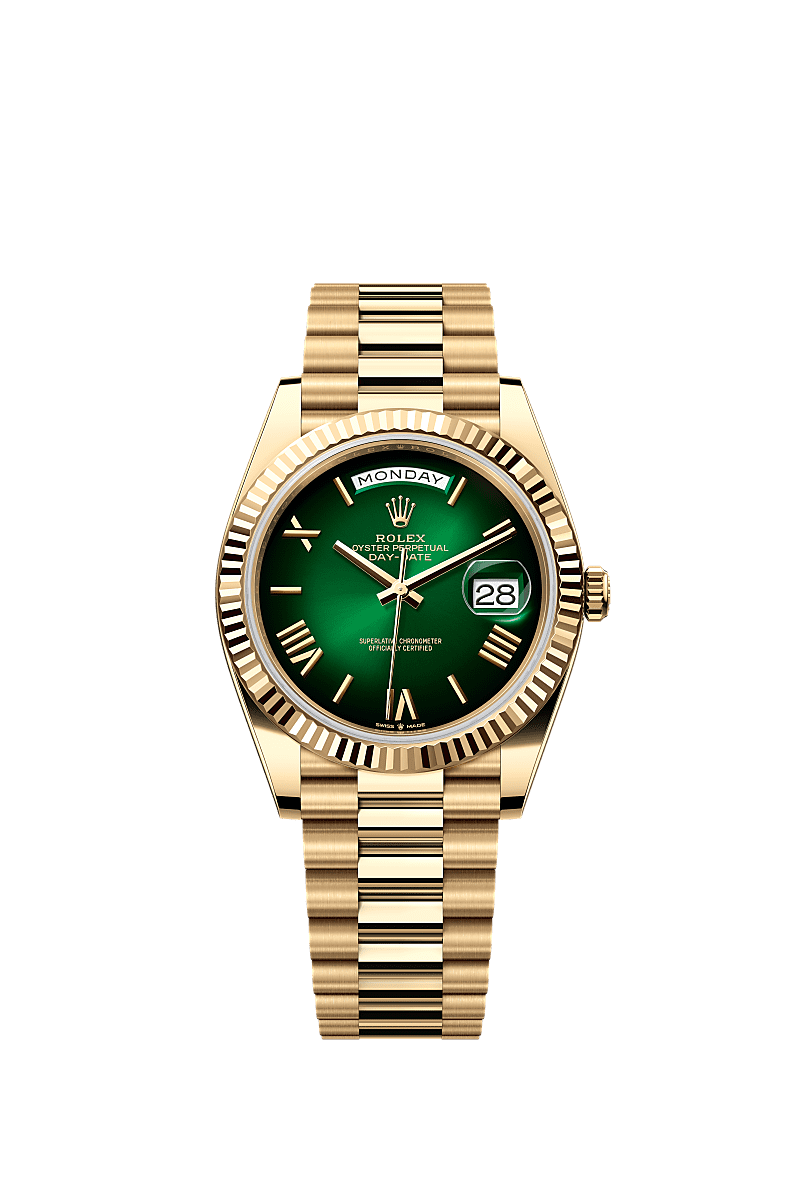
The Rolex Day-Date design brings together a full day display, a separate date window, and the rounded links of a President-style bracelet. Its proportions are familiar, but the combination has a stronger visual presence than a simple date watch. Replica versions offer a range of colors and finishes that need to be understood on their own terms.
The details that define the design
The day window across the upper dial is the feature that most clearly separates a Day-Date-style watch from a Datejust-style watch. It introduces a wide area of text into an otherwise balanced face. The date at the side adds a second display, making printing and alignment especially noticeable.
The President-style bracelet completes the look through rounded, three-piece links. Their curved surfaces catch light differently from the flatter appearance of an Oyster-style bracelet. The result can feel formal in a bright gold-colored finish or more restrained in a silver-colored version.
Understand the finish before choosing a color
Gold-colored replicas are commonly described using terms such as plated, wrapped, or coated. Those words should be accompanied by a clear statement of the base material and surface treatment. They do not mean that the case and bracelet are made from the same precious metal as an authentic Day-Date.
Ask which components receive the finish and inspect the color across the bezel, case, crown, bracelet, and clasp. Differences can be especially visible where separate parts meet. A photograph cannot establish coating thickness or guarantee how long a finish will remain unchanged.
Compare the color combinations
| Finish family | Dial combinations discussed in this guide |
|---|---|
| Yellow-gold-colored | Champagne for a coordinated look; green or black for contrast. |
| Rose-gold-colored | Brown or chocolate tones for warmth; black for a stronger outline. |
| Silver-colored | Silver, dark, or blue tones for a cooler overall palette. |
These are styling combinations, not proof that a particular pairing corresponds to an authentic factory reference. If matching a specific Day-Date design matters to you, compare the full reference description rather than mixing a dial name from one listing with a case description from another.
Lighting changes how yellow, pink, and silver tones appear. Request ordinary-light photos when a promotional image seems unusually warm or saturated. It is easier to judge consistency across components when they appear together in the same frame.
Check both calendar displays
The day should sit clearly within its curved window, with even printing and enough space around the letters. Ask to see more than one day, including a longer name. Check several date numerals as well; a single well-centered date does not show the entire date wheel.
Confirm how the calendar is set and how it advances on the supplied movement. Labels such as A3255 or A2836 may distinguish versions in listings, but the useful information is the installed movement and its actual operation. Follow the instructions for that movement rather than assuming every Day-Date-style watch sets identically.
Bracelet fit and final review
Look closely at the bracelet's rounded links, the edges between finishes, and the clasp. Check the connection to the case and confirm how many removable links or adjustment options are available. A clean-looking bracelet still needs to be sized comfortably for the wearer.
Factory names such as EW or BP may appear in descriptions, but a label alone does not establish finish quality, calendar alignment, or durability. Review photos of the actual watch and keep the agreed finish, dial, bracelet, and movement in the order record.
Use the QC checklist for the final review. If you prefer a simpler face or a different bracelet, compare the Datejust guide and the wider Rolex replica collection before selecting a configuration.