Jaeger-LeCoultre offers several distinct design languages within one name. A rectangular Reverso, a slim Master, and a sporting Polaris do not compete on the same details. When comparing replicas, the most useful approach is to identify what makes each collection appealing and then establish which of those features the individual watch actually reproduces.
Reverso: the case is the main event
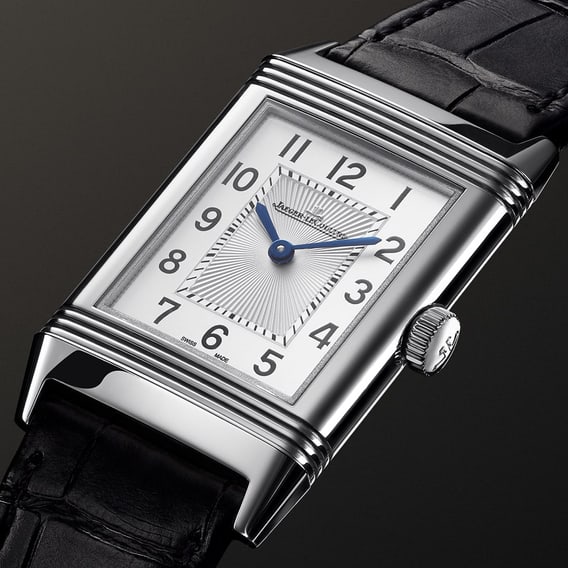
The Reverso’s rectangular case and horizontal decorative lines give it a recognizable Art Deco character. Its reversing construction is equally important. A replica should be assessed for how the case moves within its frame, how securely it sits when closed, and whether its proportions remain balanced from the side.
Ask for a video showing the complete reversal rather than relying on separate photographs of each face. For a Duoface-inspired version, confirm whether both dials function, how their times are set, and whether they provide independent displays. Two attractive faces do not by themselves establish the behavior of the mechanism connecting them.
Master: slimness and a restrained dial
The Master family uses round cases and relatively quiet layouts. The Master Ultra Thin and Master Ultra Thin Moon illustrate two approaches: a minimal time display or the addition of a moon phase and calendar detail. In both cases, the profile matters. A watch that looks delicate from above can feel quite different if the replica case is substantially thicker.
Request a side view and the actual case measurements. On a moon-phase version, inspect the disc, aperture, and surrounding date scale. Ask how the display advances and is adjusted. The moon and stars should be treated as both a visual element and a function to verify, rather than assuming either quality from the collection name.
Polaris: the sporting alternative
The Polaris brings a more substantial case and an internal timing-bezel layout to the range. Dial texture and clear separation between the hands and markers help define its appearance. Blue and darker dial treatments can look markedly different under bright studio lighting, so neutral-light images are especially helpful when choosing a color.
Check the number and function of the crowns on the exact reference. If the replica advertises an internal rotating bezel, request a demonstration showing its movement and alignment. Also review the strap or bracelet connection and clasp. Those practical details determine how comfortably the larger case sits during regular wear.
Duomètre: separate the display from the engineering
The Duomètre’s divided dial and elaborate arrangement of indications create a distinctive technical appearance. Its original dual-wing concept is a movement architecture, not simply a dial pattern. A replica can reproduce the layout while using a different mechanism, so each advertised display needs a clear explanation.
Ask which subdials operate, what they measure, and how they are adjusted. A video can clarify their behavior, while macro photographs reveal printing and hand placement. This is a useful choice to compare by specific functions rather than by a broad promise of “grand complication” accuracy.
A collection-specific inspection plan
| Collection | Most useful evidence |
|---|---|
| Reverso | Full reversal video and side photographs |
| Master Ultra Thin | Measured thickness and clear dial photographs |
| Master Moon | Moon-phase close-up and setting explanation |
| Polaris | Bezel-operation video and crown details |
| Duomètre | Demonstration of each advertised indication |
Choosing by what you enjoy wearing
The Reverso emphasizes shape and movement of the case. The Master emphasizes proportion and a calm dial, while the Polaris offers a more sporting presentation. There is no need to rank those preferences as universally better or worse. Compare one clearly identified version at a time, including its installed movement, materials, and measurements.
Explore the Reverso guide, the Master guide, or the Jaeger-LeCoultre collection at Beasts.us.com to see which design family best matches your preference.