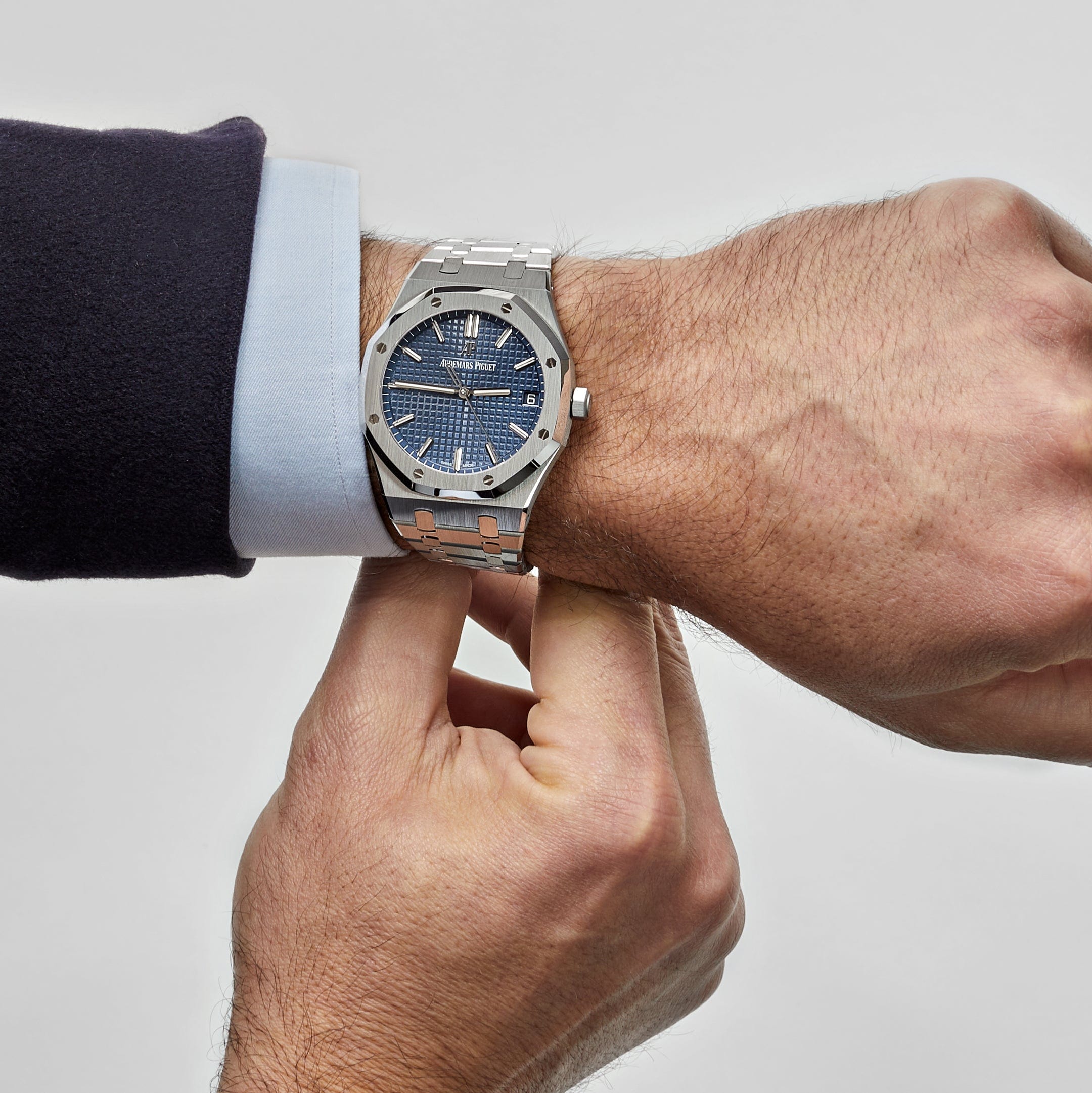
The Royal Oak’s identity comes from a group of details working together: an octagonal bezel, eight visible screws, a textured dial, and a bracelet that flows directly from the case. A replica may reproduce the outline while missing the relationships that make the design feel cohesive. This guide focuses on those details across the 15500ST, Jumbo, and chronograph styles.
The design behind the familiar shape
Introduced in 1972 and associated with designer Gérald Genta, the Royal Oak made the steel case and integrated bracelet central to its identity. Its combination of flat planes, polished edges, and patterned dial remains distinctive. On a replica, the quality of those transitions is often more useful to examine than a photograph showing only the dial straight on.
The case should appear connected to the bracelet rather than sitting above it as a separate object. Look at the angle of the first links, the gaps beside the case, and the consistency of the taper. These features influence both the appearance and the fit, especially when a broad case meets a smaller wrist.
Reading the tapisserie dial
The tapisserie pattern gives the Royal Oak dial its depth. The standard 15500ST uses the larger Grande Tapisserie treatment, while the Jumbo is associated with the finer Petite Tapisserie pattern. Compare the texture against the exact reference being represented. A grid that looks tidy in isolation can still have the wrong scale for that model.
Check that the squares remain consistent across the dial and align cleanly around markers, logos, and the date opening. Light dials reveal texture clearly; blue and darker dials can emphasize changing shadows. Request neutral-light photographs because reflections and editing can make the same finish look considerably different from one image to another.
Which Royal Oak format fits your preference?
| Style | Design emphasis | What to check |
|---|---|---|
| 15500ST | 41 mm case and a clean time-and-date dial | Dial texture, date placement, and bracelet fit |
| 15202ST Jumbo | Slim profile and a finer dial pattern | Actual thickness and the movement installed |
| 26331 chronograph | Three subdials and additional pushers | Subdial layout and demonstrated chronograph functions |
The Jumbo’s appeal is closely tied to its profile, so a head-on image is not enough. A side photograph and measured thickness help establish whether a replica retains the intended proportions. For a chronograph, case thickness, pusher alignment, and subdial spacing become just as important as the main dial texture.
Bezel and bracelet inspection
The eight bezel screws create a clear visual rhythm. Check their seating, finish, and consistent relationship to the surrounding recesses. Examine the brushed bezel surface for an even grain and the polished perimeter for a clean edge. Do not let one attractive macro photograph substitute for views of the full watch from several angles.
The bracelet deserves equal attention. Ask for photographs of the clasp, underside, and links near the case. Look for uniform brushing, smooth transitions, and a sensible range of removable links. Measurements should describe the actual example, since case diameter alone does not tell you how an integrated bracelet will wrap around the wrist.
Making sense of factory and movement descriptions
ZF, JF, and APS appear throughout Royal Oak replica discussions, but a factory label is not a complete specification. The supplied material describes modified automatic movements and decorative plates used to suggest an AP caliber’s appearance. Decoration does not establish the original movement’s construction, power reserve, or performance. Request the installed movement details for the specific version offered.
Choose the reference first, then compare its proportions, functions, and finish. The AP collection comparison explains the broader differences between Royal Oak and Offshore styles. You can also review the Audemars Piguet collection at Beasts.us.com for individual configurations.