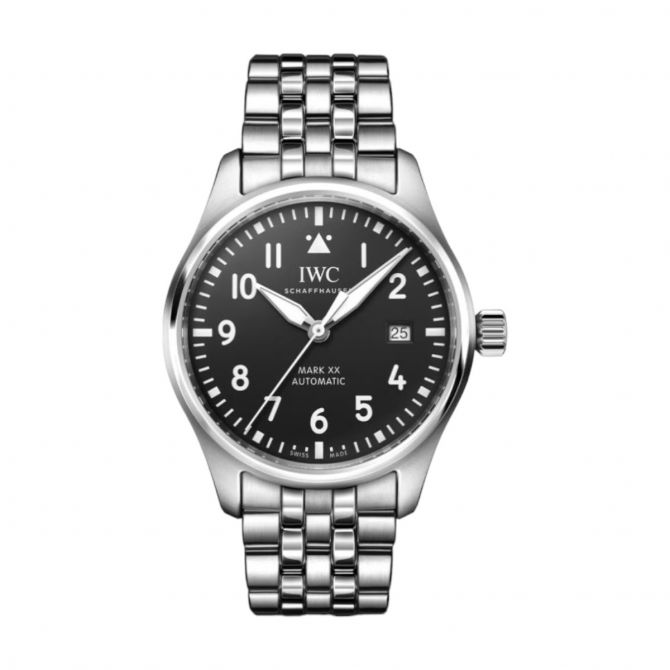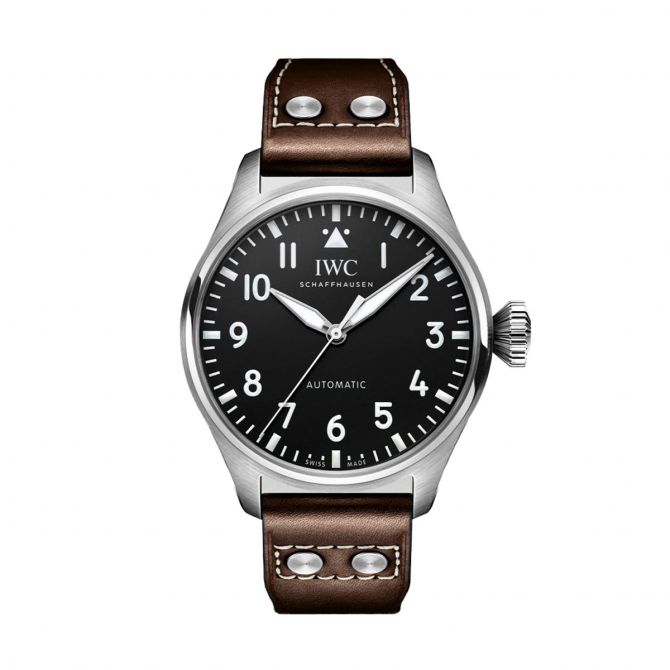
The Big Pilot makes its purpose visible: large numerals, a clear orientation triangle, broad hands, and an oversized conical crown. Its design grew from observation watches used for navigation, then developed into a modern collection with several sizes and dial layouts. When comparing an IWC Big Pilot replica, the important questions are how the watch fits and which of its apparent features actually work.
The instrument-watch foundation
The Big Pilot’s visual language favors quick reading. A dark dial creates contrast with the hands and hour markers, while the triangle at twelve helps orient the display. The broad crown gives the case a distinctive outline even when most of the dial is hidden by a sleeve.
These elements should work together. Numerals need even spacing, the minute track should sit consistently around the dial, and the hands should reach their intended scales. A simple face leaves little room to hide poor printing or misaligned markers.
43mm versus the larger format
The Big Pilot’s Watch 43 offers a more compact interpretation than the familiar 46.2mm format. The difference involves more than diameter: the simpler 43mm dial and the larger version’s power-reserve display create distinct compositions. Decide which display you prefer as well as which size suits your wrist.
| Design direction | What to compare |
|---|---|
| 43mm format | A cleaner time display, case height, and whether the strap curves down comfortably. |
| 46.2mm format | A larger dial, additional display details, overall length, and crown clearance. |
Measurements from an original reference are not a substitute for measurements of the replica. Ask for case width, thickness, and lug-to-lug length. Check the combined footprint of the case and crown, especially if you wear a watch close to your hand or spend much of the day at a keyboard.
The conical crown deserves a close look
The crown is one of the most distinctive parts of the Big Pilot. Its shape should appear balanced against the case, with clear ridges and a neat junction where it meets the case side. Damage, rough finishing, or an uneven gap can make it uncomfortable as well as visually distracting.
Request a demonstration of winding and time setting, with instructions for the installed mechanism. Do not force a crown that resists or assume that a replica uses the same crown arrangement as every original Big Pilot model.
Read power-reserve claims carefully
Some original Big Pilot references are associated with a seven-day reserve. A reproduction of the dial does not establish that running time. The reserve indicator may operate on a different scale, move in a different way, or be decorative.
Ask whether the indicator responds to winding and running down, and request the actual stated reserve of the watch being offered. Movement decoration, engraving, and a smooth seconds-hand sweep cannot independently verify the mechanism or its performance.
Dial finish and strap choice
Black, blue, and green dial treatments give the instrument layout different personalities. Evaluate color under ordinary lighting and check that luminous material is applied evenly. A bright photograph immediately after charging the dial does not show how long it remains readable.
Riveted leather straps reinforce the aviation styling, while fabric straps make the watch more casual. Check the strap’s thickness at the lugs, buckle size, and available adjustment. On a larger case, a poorly fitted strap can make the watch move around even when the diameter seems suitable.
For a broader view of the designs, explore the IWC Pilot collection guide. The IWC range at Beasts.us.com also includes quieter dial layouts for comparison.