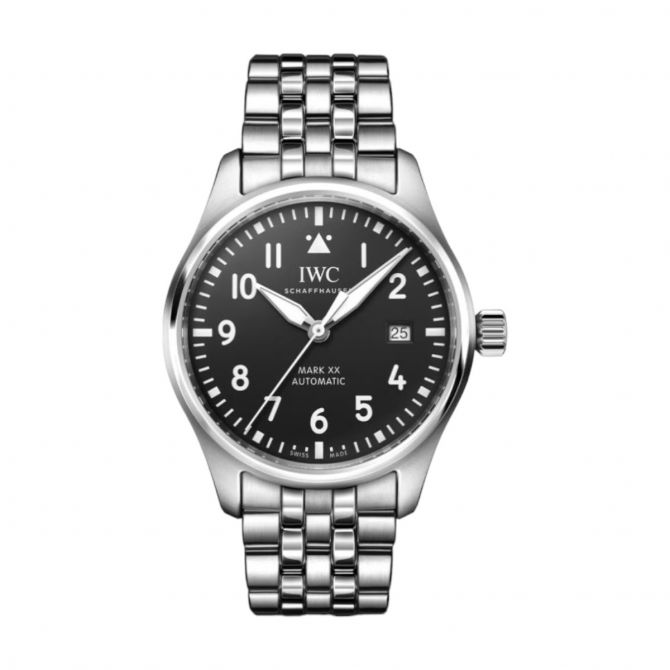
IWC’s Pilot collection brings several interpretations to the instrument-watch idea. Mark-series designs emphasize a straightforward time display, the Big Pilot enlarges the signature crown and dial, and chronographs add elapsed-time counters. A replica may reproduce the appearance of one of these families, but the original’s movement specifications and performance do not automatically carry over.
A shared visual language
The collection’s aviation heritage is reflected in contrasting hands, Arabic numerals, and the orientation triangle at twelve. These features make the dial easy to recognize without relying on elaborate decoration. The Mark 11, produced from 1948 for the Royal Air Force, is part of the history behind that instrument-focused approach.
Historical associations explain the design; they do not establish a replica’s capabilities. In particular, antimagnetic construction, water resistance, and timing performance require evidence for the individual watch. An inscription or a familiar dial layout is not sufficient.
Choose the layout that suits you
| Family | Main appeal | Details to compare |
|---|---|---|
| Mark XX | A compact, uncluttered instrument look | Dial spacing, date alignment, and bracelet or strap fit |
| Pilot Chronograph | Additional elapsed-time displays | Counter operation, pusher feel, and case height |
| Big Pilot | A large display and conical crown | Overall length, crown clearance, and any reserve indicator |
| Top Gun | Darker, technical-looking finishes | Actual case material and consistency of the surface finish |
| Spitfire | Heritage-oriented colors and case treatments | The particular reference and materials being represented |
These families overlap in visual language, but they are not interchangeable. Start with the number of functions you want and the size you find comfortable. Then compare color and finish within that group, using photographs of the actual version rather than a mixture of original and replica images.
Mark-series simplicity
The Mark XX’s approximately 40mm design provides a useful reference point for someone seeking a less imposing Pilot watch. Its open dial puts the printing, hands, and date window in plain view. Look for an evenly placed minute track and a clear distinction between the hour and minute hands.
Bracelet fit can change the experience as much as the case itself. Ask how the links are adjusted and whether the clasp offers a practical fit for your wrist. If choosing leather, check strap length and the position of the buckle after adjustment.
Chronographs and larger cases
A chronograph introduces more information and a thicker-looking profile. Request a demonstration of starting, stopping, and resetting the timing displays. Confirm what each subdial measures; a familiar counter arrangement does not prove that every counter functions as it does on the original.
The Big Pilot adds another consideration: its large crown extends the effective footprint beyond the stated case diameter. Try to compare side views and lug-to-lug measurements, especially if the watch will be worn under a fitted cuff.
Finishes require their own descriptions
Top Gun descriptions may refer to ceramic or Ceratanium, while Spitfire designs can feature bronze or steel. Those terms need to be distinguished from a matching color or surface coating on a replica. Ask for the material of the case, crown, pushers, and caseback separately if the listing is unclear.
Finish the comparison by checking the details you will use every day: legible hands, secure strap attachments, a comfortable clasp, and documented movement instructions. For a closer size comparison, read the Big Pilot guide, or browse the wider IWC collection.