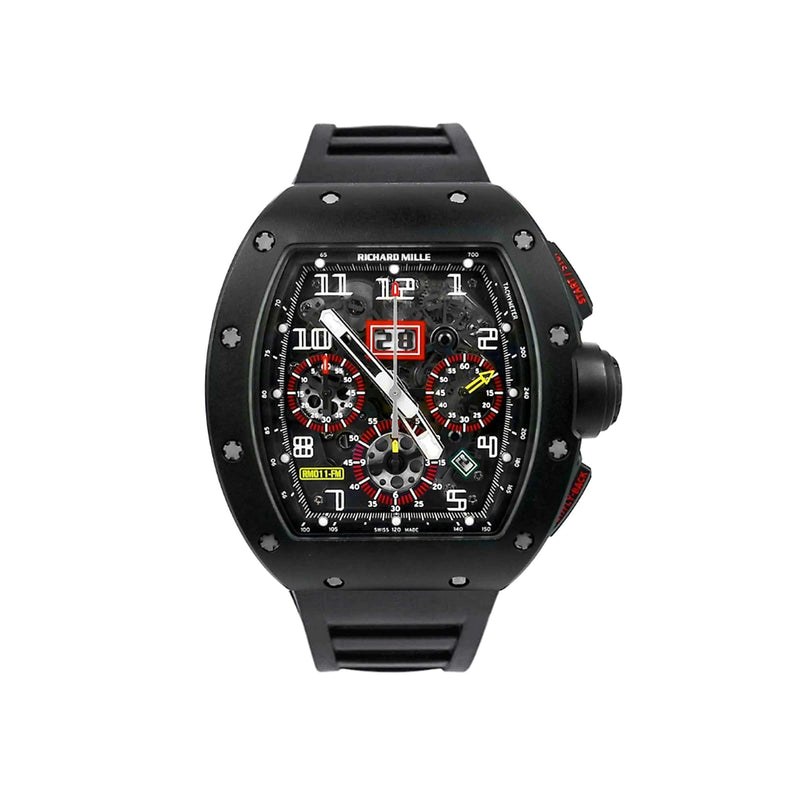
The Richard Mille RM 011 has an unmistakable shape: a large tonneau case, exposed hardware, and a dial arranged like a compact instrument panel. Replica versions aim to capture that visual impact. Comparing them requires separating the appearance of the design from the materials and mechanical functions actually supplied.
The appeal of the RM 011 layout
The RM 011 is associated with Felipe Massa and a design language influenced by motorsport. Its curved, barrel-shaped case has a different presence from a conventional round sports watch. The open dial, overlapping scales, subdials, and visible screws make the watch visually busy even when the color scheme is restrained.
The dial's depth is part of that effect. The flange, markers, subdials, and visible mechanical elements should look like distinct layers. A flat printed surface may suggest the same layout from a distance while giving a very different impression up close. Angled photos are particularly useful for understanding the construction.
Choose the case style with care
Listings commonly describe carbon-patterned, titanium-colored, gold-colored, or ceramic-style versions. The source highlights Carbon TPT's layered appearance as a defining Richard Mille feature. On a replica, however, a familiar pattern does not establish that the case uses the same material or manufacturing process as the original.
| Appearance | What to examine |
|---|---|
| Carbon-patterned | Surface texture, consistency around the case, and the stated construction. |
| Titanium-colored | Actual material description, finish, and stated weight. |
| Gold-colored | Base material, coating description, and consistency around edges and screws. |
| Bright ceramic-style | Material specification and color consistency across separate case parts. |
Choose the finish because it suits your taste, then verify what it is. The more elaborate color options can change the entire character of the watch, so compare images in ordinary light as well as promotional photographs.
A chronograph appearance is not a function list
The original RM 011 design includes chronograph and calendar features. A replica may reproduce the displays while using a movement with different capabilities. Do not infer flyback operation, calendar behavior, or a particular caliber from the dial layout alone.
Ask the seller to identify the movement and show the advertised operations. For a chronograph, that means a clear demonstration of starting, stopping, and resetting the timing display. If flyback is specifically claimed, request confirmation of how that function works on the supplied version. Also establish what each subdial displays.
Fit matters as much as the dial
The RM 011's curved case can sit differently from a round watch of similar width. Case length, thickness, strap angle, and clasp position all affect comfort. A rubber strap may suit the style, but its flexibility and available sizing are important practical details.
Request a side view and dimensions for the exact version. Check whether the strap meets the case cleanly and whether the clasp can sit comfortably beneath the wrist. There is no universal wrist-size rule that guarantees a good fit, especially with a pronounced tonneau shape.
What to check before approval
- Confirm the selected case style, color accents, and movement description.
- Inspect the case outline, screw seating, and finish around the bezel.
- Review the dial from an angle to understand its depth and construction.
- Verify the functions of the pushers, calendar displays, and subdials.
- Check the strap attachment, clasp, and sizing information.
Factory labels such as KV may help identify a listing, but the individual watch still needs review. See the factory guide for terminology, then compare the Richard Mille replica collection with the simpler RM 035-style design if you prefer a less crowded dial.