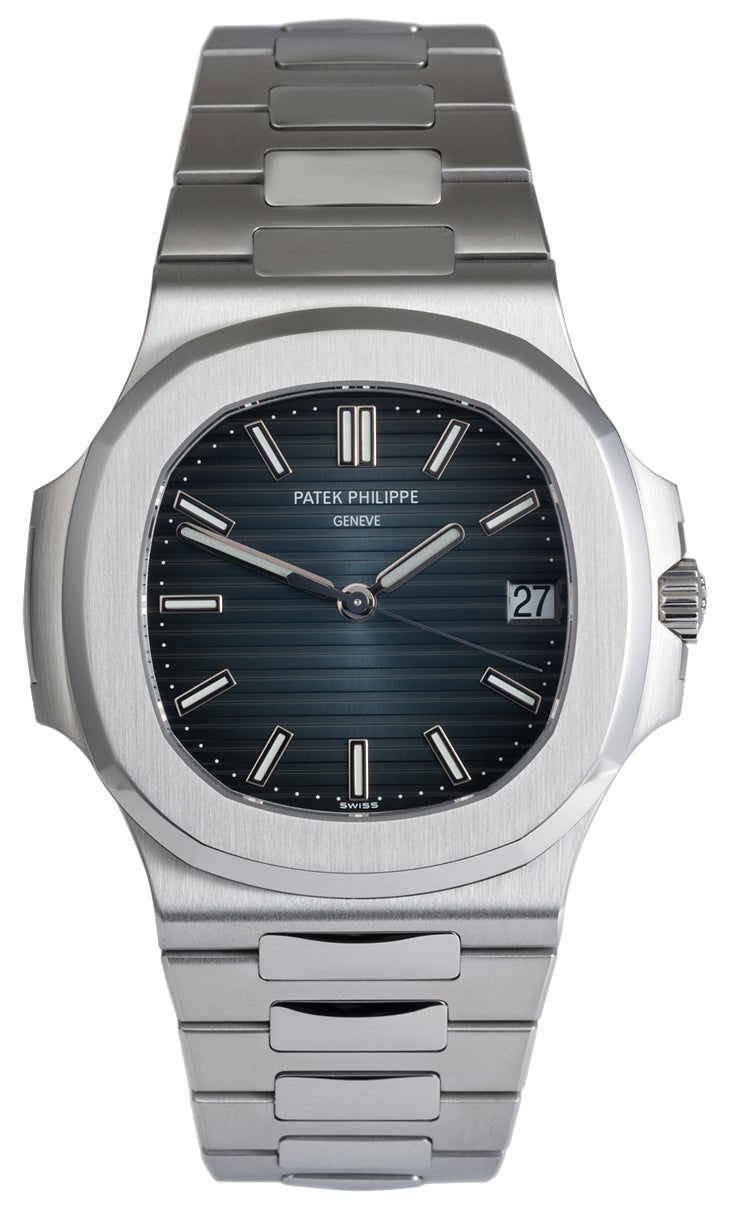
The Patek Philippe Nautilus combines a broad, rounded bezel with a slim profile and an integrated bracelet. Its horizontal dial texture gives the watch a recognizable identity without a crowded face. A Nautilus replica may reproduce that appearance, but its materials, movement, and finishing need to be assessed separately from those of an authentic Patek Philippe.
Start with the reference
The 5711 is the simplest place to begin. Its uncluttered dial puts the hands, applied markers, and date window in the foreground. The familiar blue-black dial emphasizes the contrast between a lighter center and darker edges, while white, green, and brighter blue versions create a different impression using the same basic layout.
The 5712 adds visual complexity through its moonphase, date, and power-reserve displays. Those details matter mechanically as well as aesthetically: a replica can copy the arrangement without providing every function. The 5811 follows the same design family with revised proportions and details. Compare the exact reference in a listing instead of treating all three as interchangeable.
What gives the dial its character?
Horizontal embossing is central to the Nautilus look. The lines should remain consistent across the visible dial, with clean edges around markers and apertures. On gradient versions, look for an even transition in color rather than a sudden band between the center and perimeter. Lighting can change both the apparent shade and the strength of the texture.
A Tiffany Blue-style dial is a much more conspicuous choice than dark blue or black. Judge its finish in several lighting conditions, and remember that a recognizable color does not establish an edition's authenticity. With any dial, legible printing, straight markers, and a well-centered date are more useful inspection points than a seller's numerical accuracy score.
Case and bracelet details deserve equal attention
The Nautilus case has distinctive extensions at the sides, often called ears. Their shape, the curve of the case, and the relationship between bezel height and overall thickness influence how the watch looks and wears. A straight-on photo can conceal an overly thick case, so request a side view as well.
The integrated bracelet should appear to flow from the case. Check the transition into the first links, the separation between brushed and polished surfaces, and the consistency of the link edges. Fit also depends on available adjustment and the behavior of the clasp. A bracelet that photographs well may still feel stiff or pinch when sized incorrectly.
Understand factory and movement descriptions
Listings may use names such as 3KF or PPF to identify a particular version. These labels help organize comparisons, but they do not prove that every example has identical parts or quality. Ask for the version being offered and photos of the actual watch. Compare equivalent references and dial colors before drawing conclusions.
A decorated movement can resemble a Patek Philippe caliber through the caseback while using different underlying architecture. Ask which movement is installed, how it is wound and set, and which displays work. For a 5712-style model, request a demonstration of the moonphase, date, and power-reserve indicator rather than relying on a still photograph.
A practical inspection checklist
- Check dial printing, marker alignment, date centering, and horizontal texture.
- Compare front and side views for the case shape and thickness.
- Inspect the bracelet junction, clasp, and finishing transitions.
- Confirm every advertised complication with a clear demonstration.
- Keep the agreed reference, dial color, and movement description with your order details.
Use the QC photo guide to organize those checks, then compare the available Patek Philippe replica styles. The right choice begins with a design you enjoy and a clear understanding of the specific watch being offered.