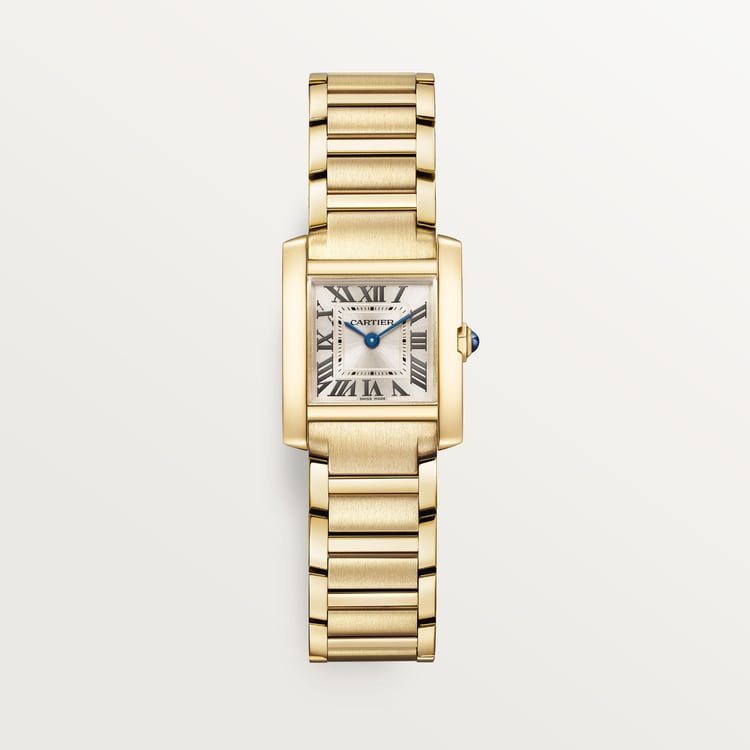
The Cartier Tank is defined by a simple relationship: a rectangular dial framed by two extended vertical sides. Those side sections, often called brancards, give the watch its structure and connect the case to the strap or bracelet. When comparing replicas, the proportions of that frame matter as much as the familiar Roman numerals and blue hands.
A long-running design with several interpretations
The Tank design dates to 1917. Over time, Cartier developed variations that kept the rectangular idea while changing the case shape, bracelet, and dial. That variety is useful to understand before choosing a replica, because “Tank” does not describe one set of dimensions or one movement configuration.
The Must and Solo emphasize a relatively straightforward rectangular presentation. The Française makes the metal bracelet a central part of the design. Louis Cartier styles place emphasis on a softer dress-watch treatment, while the Américaine uses a longer, curved form. Each calls for a different comparison of width, length, and profile.
Tank Française: case and bracelet together
Introduced in 1996, the Tank Française connects its rectangular case to an articulated metal bracelet. The overall effect depends on how the first links meet the brancards and how the bracelet continues their lines. A front photograph should be supplemented with views of the clasp, underside, and bracelet resting naturally.
Compare the specific generation and size represented by the replica. Different Française versions change the case proportions, dial details, and movement type. A small, medium, or large label should therefore be accompanied by actual measurements rather than treated as a universal specification.
Tank Must and Solo: the strap changes the mood
Must and Solo-inspired designs often pair the rectangular case with a leather strap. Black gives a familiar, restrained appearance, while brown, burgundy, and brighter colors change the balance between dial and case. Look at the strap’s width, stitching, thickness, and fit between the brancards rather than choosing by color alone.
A simpler case also makes its outline more noticeable. Check that the vertical sides have clean, consistent edges and that the dial opening is neither too square nor overly elongated for the intended reference. A side view helps establish whether the replica retains the design’s relatively slim appearance.
Dial details and the crown
The Roman numerals, rectangular minute track, hands, and central text should form an orderly composition. Inspect the spacing at the corners and the weight of the printing. Where a reference uses the watchmaking numeral IIII, compare that detail with the intended design rather than assuming all Tank dials are identical.
The blue cabochon-style crown should sit neatly beside the case. Its color and shape can be reviewed in photographs, but a gemstone claim needs a specific material description. Likewise, a gold-colored case should not be confused with a solid-gold one. Ask what the replica’s case and buckle are made from.
Quartz, automatic, and special features
Tank replica listings may offer quartz or automatic movements depending on the version. Confirm the mechanism actually installed rather than inferring it from the case size. A quartz movement can suit a thin, simple presentation, while an automatic version may have different dimensions and setting behavior.
SolarBeat wording requires particular care. A replica styled after a SolarBeat Tank should not be assumed to include Cartier’s light-powered technology. The seller should explain how the watch is powered and maintained. The same principle applies to any special feature borrowed from an original model’s name.
What to compare before choosing
- Case width, length, and thickness for the exact version.
- The shape and finish of the brancards.
- Dial printing, hand proportions, and crown placement.
- Strap fit or bracelet articulation and clasp construction.
- The installed movement and any advertised special functions.
The Tank emphasizes a rectangular silhouette and restrained details. If you prefer a broader square case, compare the Santos; for a more bracelet-focused design, explore the Panthère. Browse the Cartier collection at Beasts.us.com for individual configurations.