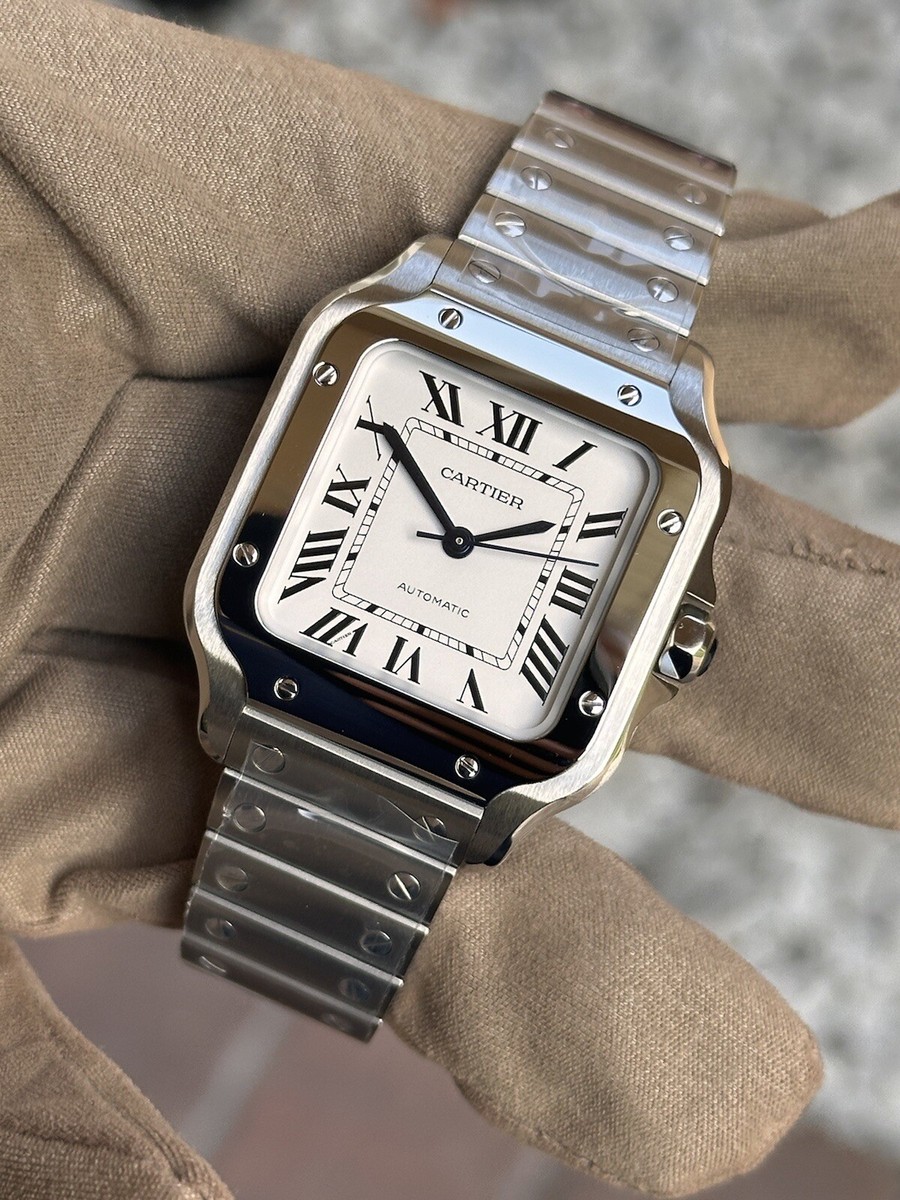
The Santos de Cartier combines a square case, visible screws, Roman numerals, and a bracelet that carries the case’s geometry around the wrist. Its identity depends on how those details work together. A useful replica comparison starts with proportions and finishing, then checks whether any advertised bracelet or movement features are actually included.
From aviation origins to a familiar shape
The Santos traces its origins to Louis Cartier’s 1904 watch for aviator Alberto Santos-Dumont. The square form and exposed hardware remain central to its character, even as later designs have changed the case, dial, and bracelet. Those historical associations describe the original collection; a replica reproduces its appearance rather than its brand provenance.
The Santos de Cartier redesign introduced in 2018 placed renewed emphasis on the transition between bezel, case, and bracelet. The result has a more continuous outline than a watch with a conventional strap attachment. Side and angled photographs are useful because they reveal how that transition has been interpreted in a replica.
Medium and large are different experiences
The medium WSSA0029-style case is commonly described at about 35.1 mm wide, while the large WSSA0018-style case is about 39.8 mm wide. A square case should not be judged as if it were a round watch with the same diameter. Its length, corners, and bracelet attachment influence how much wrist area it occupies.
The medium gives the design a more compact balance; the large makes the bezel, screws, and dial more prominent. Ask for the actual replica’s width, length, and thickness, along with a wrist photograph if available. Compare the date layout as well, since the two sizes are not simply scaled copies of one another.
Bracelet systems need to be demonstrated
SmartLink and QuickSwitch are associated with the original Santos bracelet and strap systems. A replica listing may use those names, but it should explain the functions included in that particular version. Ask to see link adjustment and strap removal demonstrated if they are advertised.
Inspect the clasp, the links near the case, and the bracelet’s underside. The visible screws should be neatly seated, and the polished and brushed surfaces should have clear boundaries. Also ask about sizing range and spare links so that the watch’s fit can be evaluated before any adjustment.
Dial and bezel details
The silver opaline style gives the Santos a familiar Cartier appearance, while blue, gray, and dark-finish versions create different effects. Use neutral-light images to assess color and texture. Strong reflections can make a brushed surface look polished or conceal a soft edge in the printing.
- Check the Roman numerals and minute track for even spacing.
- Inspect the shape and finish of the hands.
- Look at each bezel screw and its surrounding recess.
- Review the curve where the bezel meets the bracelet.
- Check the seating of the blue cabochon-style crown detail.
- Inspect the date opening where the chosen version includes one.
Movement and material descriptions
BV, BVF, GF, and other labels may appear in Santos replica discussions. They should identify a particular version, not stand in for its specification. Ask which movement is installed and how its functions operate. A caliber number associated with an original Cartier does not by itself identify the mechanism in a replica.
Steel, two-tone, and dark-coated designs also need precise material descriptions. Gold tone is a finish unless solid gold is explicitly established, and a black case does not prove a particular coating process. Evaluate the stated materials together with close photographs of the edges, crown, and clasp.
Comparing Cartier’s geometric designs
The Santos offers a broad, square outline with visible hardware. The Tank takes a more elongated approach, while the Panthère gives the bracelet a softer role. Browse the Cartier collection at Beasts.us.com to compare their proportions.