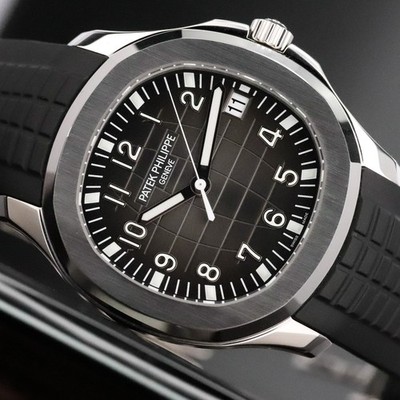
The Patek Philippe Aquanaut pairs a rounded octagonal case with a patterned dial and a distinctive composite-strap design. Introduced in 1997, the collection developed a more casual identity alongside the Nautilus. A replica may reproduce that appearance, but the materials, movement, and practical performance need to be described for the specific watch being offered.
The relationship between dial and strap
The Aquanaut’s embossed grid is a central part of its character. The pattern continues visually onto the strap, connecting the face of the watch to the wrist. Compare the depth and regularity of the dial texture, the placement of the numerals, and the way the strap meets the case.
A close-up should show clean printing and consistent texture without losing the overall shape of the dial. Neutral-light photographs are particularly useful on colored versions, where bright lighting and camera processing can change the apparent shade.
5167A and 5168G design directions
The 5167A provides a familiar reference point with a black patterned dial, date display, and relatively compact case. The 5168G presents a larger interpretation, including the khaki-green design discussed in this guide. Those differences affect both the visual balance and the amount of wrist space the watch occupies.
| Design direction | What stands out | What to compare |
|---|---|---|
| 5167A style | A restrained black dial and matching strap | Case height, date alignment, and dial texture |
| 5168G style | A larger case and distinctive color options | Actual dimensions, color in ordinary light, and case material |
| Chronograph style | Additional timing display and pushers | Counter operation, pusher controls, and added thickness |
The original 5168G’s precious-metal construction should not be assumed for a replica. A steel case, a coated case, and a solid precious-metal case are different products even if their colors look similar. Ask for the actual material rather than inferring it from the original reference suffix.
Chronograph and travel displays
The Aquanaut family includes more than one complication direction. A chronograph measures elapsed time; a travel-time display provides another time indication. A listing should identify which reference it represents and which functions the replica actually performs, without combining different models’ specifications.
For a chronograph, request a demonstration of starting, stopping, and resetting the timing display according to the installed movement’s instructions. If a second time indication is advertised, ask how it is adjusted and whether it can be set independently. An original Patek caliber name is not enough to answer these questions.
Strap material and adjustment
Patek’s Tropical strap terminology describes the original product. A replica strap should have its own material description, with no assumption that the compound or durability is identical. Inspect the edges, flexibility, and consistency of its patterned surface, along with the fit at the case.
Ask how the strap is sized before making adjustments. Some arrangements may require permanent trimming, so confirm the fit and procedure first. The clasp should close securely and rest comfortably beneath the wrist rather than pressing into a single point.
Keep performance claims separate
A casual sports-watch appearance does not establish water resistance or suitability for vigorous activity. Confirm the actual movement, operating instructions, dimensions, and any documented performance claims. Factory labels and similarity percentages are less useful than clear information about the offered item.
For a round dress-watch alternative, read the Calatrava guide. To explore more elaborate displays, see the Complications guide or browse the Patek Philippe collection.