A complicated watch adds information or functions beyond a basic time display. Within Patek Philippe’s designs, calendars, chronographs, travel-time indications, and world-time displays each solve a different problem. A replica can reproduce their visual arrangement without reproducing the same mechanism, so the most useful comparison separates what a dial shows from what the watch actually does.
Understand the function before the reference
An annual calendar distinguishes between thirty-day and thirty-one-day months, with a correction needed around the end of February. A chronograph measures elapsed time. A travel-time display provides another time indication, while a world-time layout relates a time scale to a ring of representative cities.
These functions require different mechanisms. Working hands or a moving disc may reproduce only part of an original complication. Ask for a plain-language explanation of each display rather than relying on a broad claim that every function works.
| Complication | Evidence to request |
|---|---|
| Annual calendar | An explanation of month-length handling and required corrections |
| Chronograph | A demonstration of start, stop, and reset |
| Travel time | A demonstration of how the second time indication is adjusted |
| World time | An explanation of how the city and time rings relate and advance |
| Moon phase | Confirmation that the display follows a lunar cycle rather than a daily cycle |
5726-inspired calendar designs
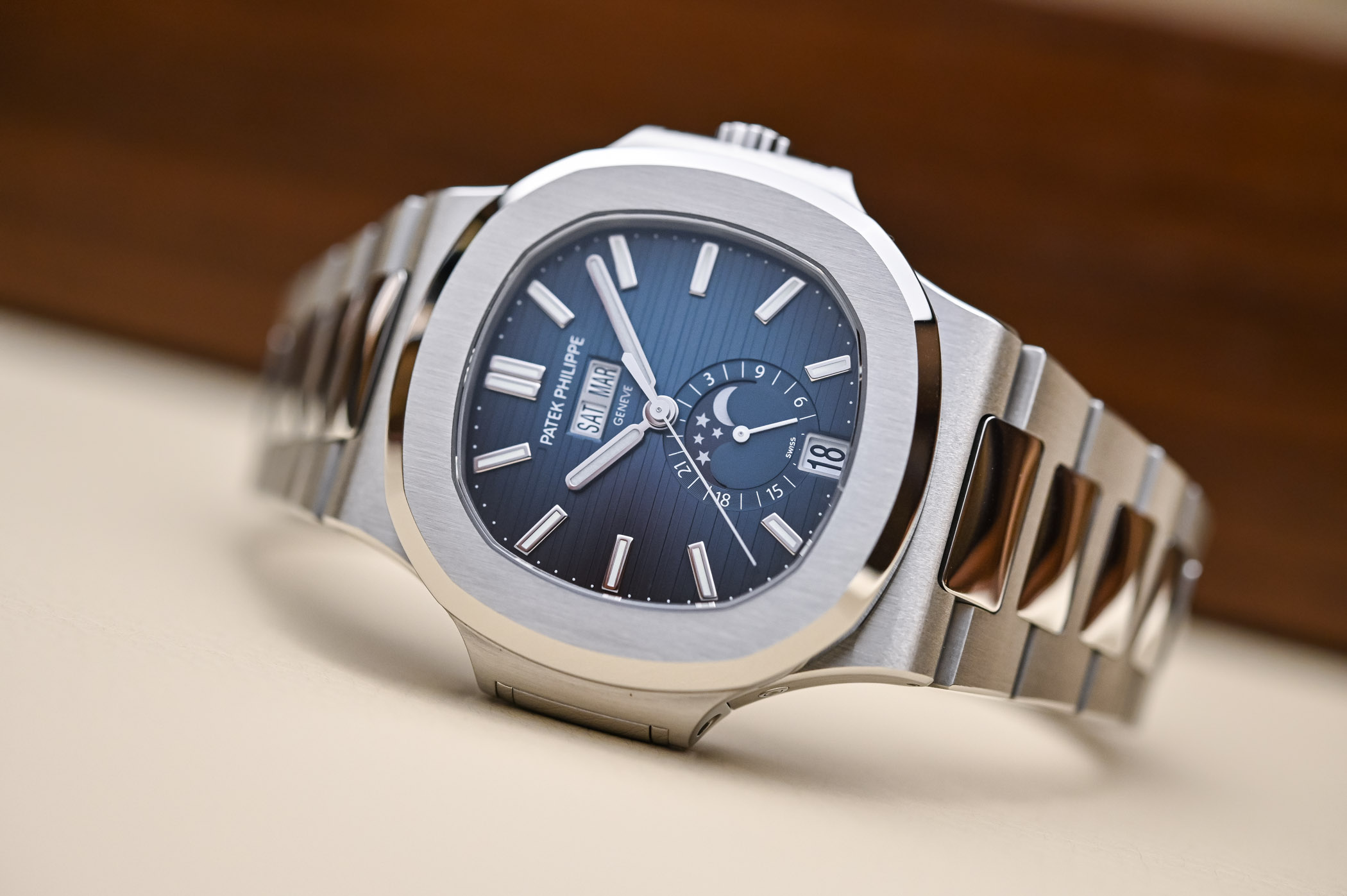
The Nautilus 5726 combines the recognizable case shape with calendar and moon-phase information. Its appeal comes from integrating those displays into a sports-watch format. On a replica, establish whether the calendar has genuine month-length logic or simply presents separate day, date, and month indications.
A date that advances each day does not by itself make the watch an annual calendar. Similarly, a manually adjustable month disc is different from a month display coordinated by an annual-calendar mechanism. These distinctions should be stated clearly in the product description.
5990-inspired chronograph and travel displays
The Nautilus 5990 combines chronograph and travel-time ideas in a busy but organized layout. A reproduction may use a simpler arrangement internally, even when the case controls and counters resemble the original.
Ask which pushers operate which functions and what each counter measures. Confirm whether the second time indication can be adjusted independently and whether any day/night display is linked to the appropriate time. Flyback behavior should be specifically documented; do not attempt a flyback reset on a movement described only as a standard chronograph.
5131-inspired world-time designs
The World Time 5131 is known for combining a city ring with a decorative map at the center. The map is part of the aesthetic, while the surrounding displays provide the functional concept. A replica may imitate the artwork using a different process from the original enamel work.
Confirm whether the city ring moves, whether the time scale advances, and how the two are coordinated. A rotating ring alone does not establish that the watch provides the same integrated world-time operation as the original reference.
Operating instructions and service matter
Request instructions for the installed movement, including any restrictions on calendar adjustment. Original Patek manuals may not describe the replica’s controls correctly. A clear demonstration is more useful than a list of original specifications copied into a sales description.
Also ask about repair options and parts for the actual mechanism. Choose the dial for its visual appeal with a clear understanding of its functions and limitations. For simpler layouts, compare the Calatrava and Aquanaut guides within the Patek Philippe collection.