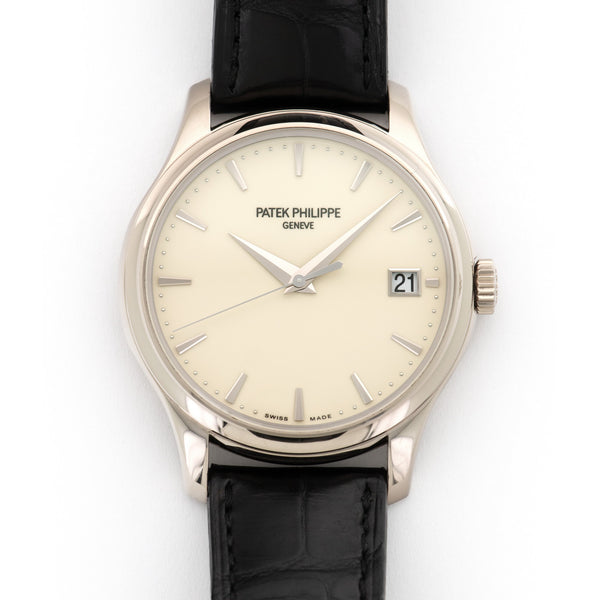
The Patek Philippe Calatrava places most of its visual emphasis on proportion and finishing. A round case, clear dial, and fine hands leave little to distract from the way each part is made. That simplicity is why a Calatrava replica deserves close attention to case shape, marker alignment, and surface finish rather than a broad promise of similarity.
A collection built around restraint
Calatrava designs vary, but many share an open dial and a relatively slim profile. Some focus almost entirely on hours and minutes, while others add small seconds or a date. The relationship between the bezel width, the length of the hands, and the placement of the hour markers determines the overall balance.
Look at a straight-on photograph before studying close-ups. The watch should first work as a complete composition. Then examine the printing, applied details, and edges of the hands, where roughness or misalignment can be especially visible on a quiet dial.
The 5227 and its hinged caseback
The 5227 is associated with a hinged protective cover over the display caseback, often described as an officer-style detail. It adds a discreet mechanical feature to an otherwise restrained watch. On a replica, confirm whether the cover opens and closes as intended and whether it sits evenly when shut.
Request photographs of the closed back, the open cover, and the movement beneath it. The hinge and catch should be described as part of the actual product. Do not force a cover that resists, and do not assume that a decorated movement has the same architecture as the original.
The 6119 and Clous de Paris styling
The 6119 family brings attention to the textured Clous de Paris, or hobnail, bezel. That repeated pattern changes how light moves around the dial and makes the regularity of the small details important. Check that the pattern remains consistent around the entire bezel rather than judging one enlarged section.
Compare the exact reference and color combination. Dial finishes and case metals vary, and a replica listing should not borrow a dial description from a different version. A familiar collection name does not make every combination part of the original range.
| Detail | Useful inspection |
|---|---|
| Smooth dial surface | Even color, clean printing, and no visible marks |
| Applied markers | Consistent alignment and neat edges |
| Faceted hands | Clear finishing and suitable length |
| Textured bezel | Regular pattern and clean transitions |
| Hinged back | Secure closure and an even fit |
Materials and case proportions
Gold-tone appearance should be distinguished from solid precious-metal construction. Ask whether the replica uses plating, another coating, or an uncoated base material, and which components receive that finish. Weight alone is not a reliable material test.
Obtain the actual case height and lug-to-lug length as well as diameter. A thicker replica movement or raised caseback can change the way a dress-oriented watch sits beneath a cuff. The lugs should follow the wrist without projecting noticeably beyond it.
Choose the strap as part of the design
A leather strap contributes strongly to the Calatrava’s appearance. Smooth and textured surfaces give different effects, while heavy padding can alter the impression of a slim case. Check the stated material rather than assuming that an embossed pattern identifies a particular hide.
Inspect stitching, edge finishing, buckle size, and available length. For a more casual case-and-strap design, compare the Aquanaut guide. The wider Patek Philippe collection at Beasts.us.com provides other dial and case approaches to consider.