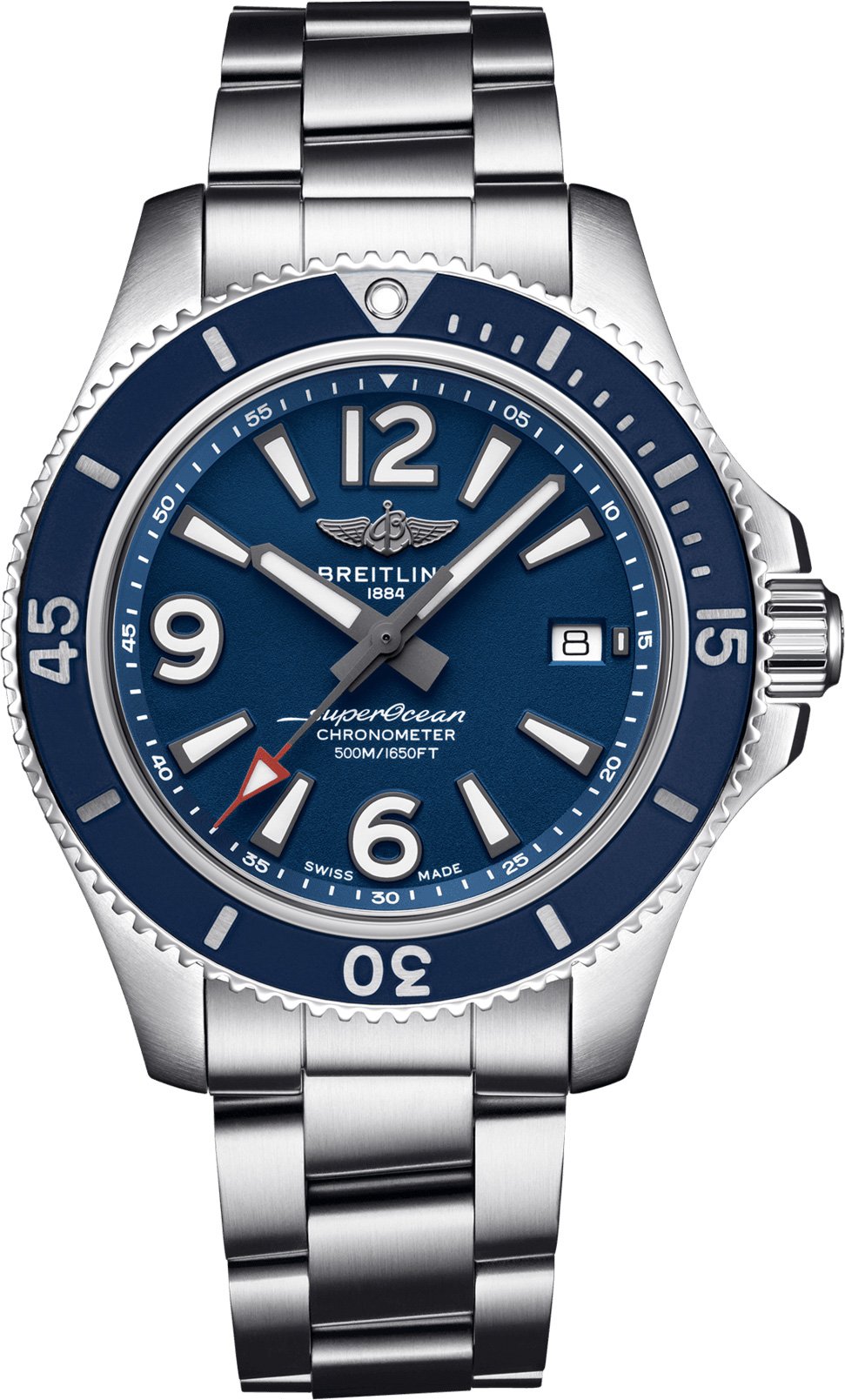
The Breitling Superocean combines a bold sports-watch case with a clear dial and a rotating timing bezel. Its appearance is less crowded than the Navitimer’s, but that simplicity puts more attention on alignment, contrast, and case proportions. A replica should be assessed as an individual watch, with its materials and performance described separately from the original collection’s diving heritage.
Superocean and Heritage are different designs
The Superocean name dates to 1957, and later interpretations have taken the collection in several directions. Modern Automatic styles use prominent markers, contrasting hands, and a substantial bezel. The Heritage family draws more directly on a vintage-inspired appearance, including a different dial treatment and mesh-bracelet options.
Compare like-for-like references when reviewing a replica. Hand shapes, marker styles, date placement, and bezel details vary between generations and subcollections. A photograph labeled only “Superocean” may not provide enough information to judge which design it is intended to reproduce.
Bezel details deserve close attention
The bezel is both a prominent visual element and, where functional, a moving control. Check the reference marker against the dial, the spacing of the numerals or markings, and the consistency of the finish. Request a video of its operation so you can see how it moves and where it settles.
Material descriptions should refer to the exact component. Some listings emphasize a ceramic insert, while others describe a different surface treatment. Neither a glossy finish nor a collection name proves the material. Ask what the bezel and case are made from individually instead of transferring specifications from an original Breitling reference.
Readability and dial finishing
Clear contrast is part of the Superocean’s appeal. Look for hands that remain distinguishable from the markers and dial, especially on bright color combinations. Applied details should be evenly positioned, and any date opening should have a centered number. Small flaws become easier to see when the layout contains fewer competing elements.
If luminous material is advertised, an image can show its distribution and color, but a photograph alone cannot establish how long it remains visible. Inspect the daytime application as well as any dark image. Uneven fill, rough edges, or mismatched areas may be more apparent under ordinary lighting.
Choose the size as a complete package
Superocean styles discussed across the range include 42 mm, 44 mm, and 46 mm cases. The larger versions change more than dial area: thickness, lug shape, and bracelet width all affect the impression. Compare the actual measurements of the replica and consider where its strap begins to turn downward.
A rubber strap can emphasize the sporting character, while a steel bracelet creates a more continuous outline. Heritage-inspired mesh has a different feel and needs its own inspection. Look at the clasp, adjustment range, and how the bracelet meets the case rather than judging only the visible pattern.
Movement and water-resistance descriptions
Replica listings may identify an Asian 2824-style movement, a Miyota movement, or another automatic mechanism. Confirm the installed version and its setting procedure. A solid caseback can conceal the movement, but it does not remove the need for a clear description of what powers the watch.
The model name and dive-watch appearance do not establish the replica’s water resistance. Any intended water use should be based on information and testing relevant to the actual watch. Avoid assuming it shares the original reference’s rating simply because that rating appears on the dial or in the model name.
Comparing the Superocean with other Breitlings
The Superocean suits a preference for a clear dial and prominent timing bezel. The Navitimer adds intricate aviation scales, while the Premier takes a more restrained chronograph approach. Explore the Breitling collection at Beasts.us.com to compare the exact configurations.