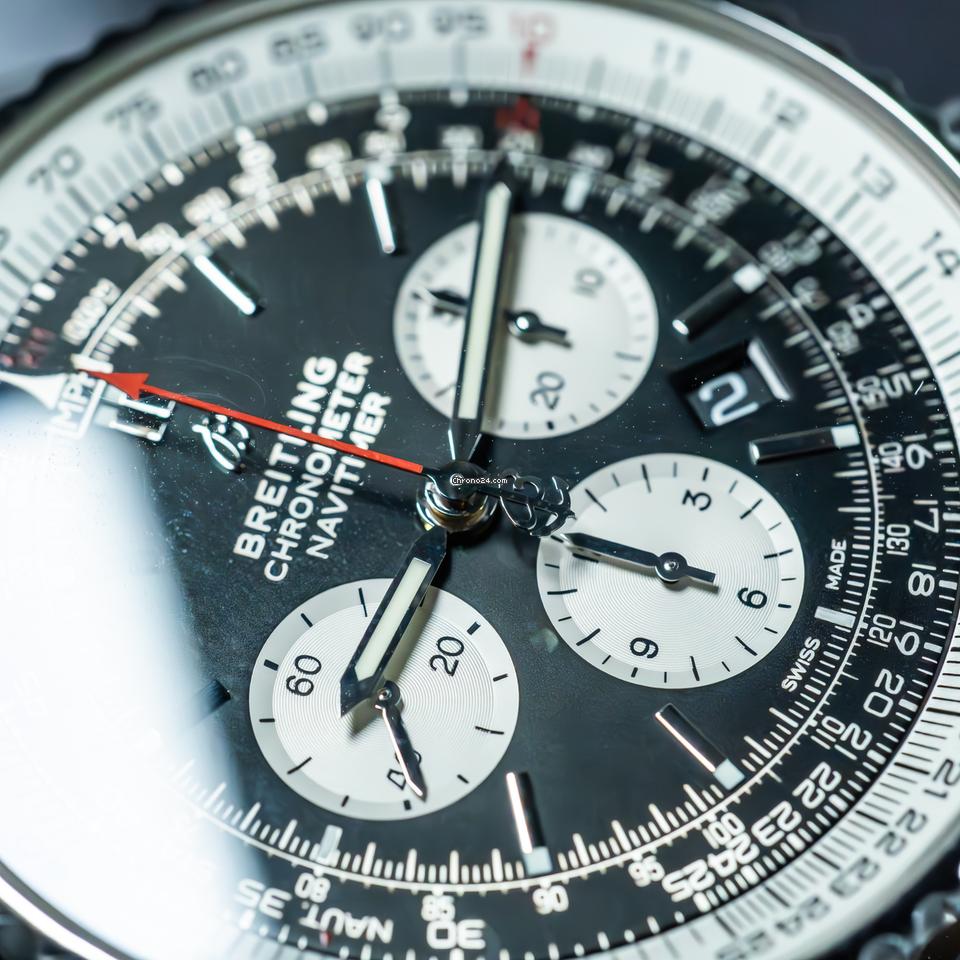
The Navitimer’s identity is concentrated in its dial: a chronograph surrounded by dense scales and a rotating slide-rule bezel. That arrangement gives the watch a distinctive aviation character, but it also creates many details to inspect on a replica. Clear printing, balanced spacing, and working controls matter more than a broad claim of visual accuracy.
A design built around information
Introduced in 1952, the Navitimer brought calculation scales and chronograph timing into one wristwatch design. Its appeal still comes from that instrument-like layout. The dial is intentionally busy, so the useful question is whether the information remains orderly and readable rather than whether there are enough markings to look convincing from a distance.
Compare the exact reference represented by the replica. Dial colors, logos, subdial arrangements, date placement, and case sizes vary across Navitimer styles. A detail that looks unusual on one version may belong to another, which makes a clearly identified reference important before judging the photographs.
The slide-rule bezel
The rotating scale is central to the Navitimer’s appearance. Inspect the numerals around its full circumference, including the small spaces between them. Printing should remain consistent, with clean edges and no obvious crowding or gaps. Check how the moving and fixed scales relate at more than one position.
Ask for a video showing the bezel turning in both directions if that operation is advertised. The demonstration should make its movement and alignment visible. A detailed scale can be decorative or functional, so the seller should explain what is being supplied rather than letting the resemblance answer that question.
Chronograph layout and movement descriptions
Replica listings may describe a B01-style movement or an adapted chronograph platform. Those terms need clarification. The external layout can resemble a Breitling design while the underlying mechanism differs. Ask which registers work, what each one measures, and how the watch is wound and set.
A useful operating video shows the chronograph starting, stopping, and resetting. Check where the central timing hand returns and how the elapsed-time registers behave. The running seconds display should not be confused with a chronograph counter. For a display-back version, inspect the movement photograph separately from the demonstration of its functions.
Dial details that reward a closer look
- Subdials should be centered and consistently printed.
- Hands should be easy to distinguish from the surrounding scales.
- Applied markers should sit evenly and reflect light consistently.
- The date should be centered in its opening where fitted.
- The logo and small text should remain clear without rough edges.
- The bezel should sit evenly around the dial.
Use a straight-on photograph for alignment and a slightly angled view for depth. Strong reflections can hide uneven printing or make a marker appear tilted, so several ordinary-light images are more useful than one polished promotional shot.
Choosing a size and strap
Navitimer chronograph styles commonly discussed in this range include 41 mm, 43 mm, and 46 mm cases. Larger versions give the scales more space but create more wrist presence. Compare thickness, case length, and the shape of the lugs as well as diameter. A wrist photograph can help put the measurements into context.
A steel bracelet emphasizes the watch’s bright, technical appearance, while leather gives it a softer outline. Inspect the bracelet’s links and clasp, or the strap’s stitching, fit, and buckle. Do not assume the strap choice determines whether the watch has a display or solid caseback; confirm that feature directly.
Where the Navitimer fits
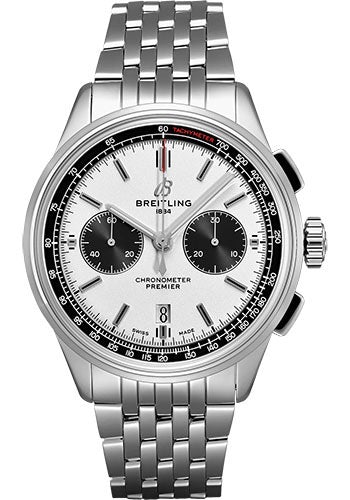
The Navitimer suits someone who enjoys intricate scales and an aviation-inspired chronograph. If you prefer a cleaner dial, compare the Premier; for a rotating-bezel sports style, consider the Superocean. Browse the Breitling collection at Beasts.us.com for individual configurations.