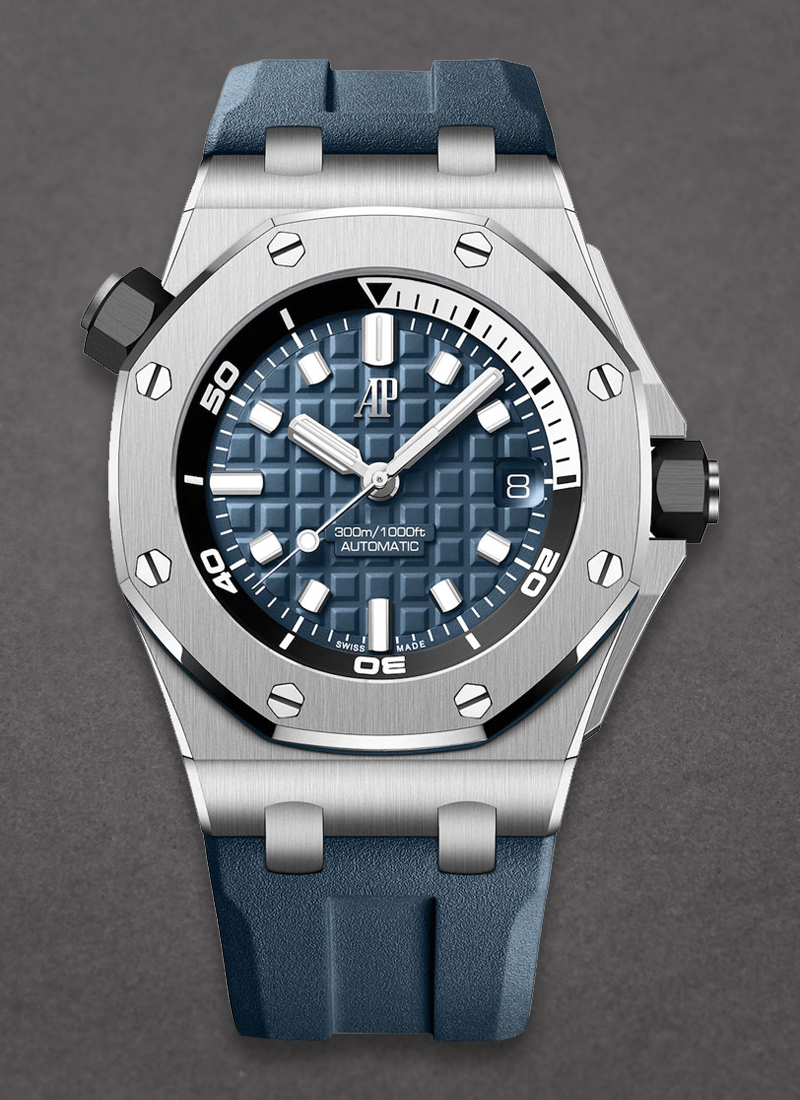
The Audemars Piguet Royal Oak Offshore takes the Royal Oak's angular design language in a larger, more assertive direction. A prominent bezel, textured dial, substantial case, and rubber strap give it a different character from the slimmer bracelet-focused Royal Oak. Replica comparisons should start with whether you prefer the Diver or Chronograph layout.
Diver-style or Chronograph-style?
The 15710ST-style Diver has a comparatively open dial, a date window, and a rotating inner bezel. Without chronograph counters, the patterned dial and large markers become the main features. Its additional crown is a visible part of the design and should be understood in relation to the inner bezel's operation.
The 26470ST-style Chronograph adds three subdials and prominent pushers. It creates a busier face and a more instrument-like appearance. That visual complexity also adds questions about function: each counter and pusher should do what the listing says it does.
| Layout | Design focus | Function to confirm |
|---|---|---|
| Diver-style | Large markers and an inner timing bezel. | Inner bezel adjustment and date operation. |
| Chronograph-style | Subdials, pushers, and a denser display. | Timing start, stop, reset, and the purpose of each counter. |
The patterned dial and angular bezel
The Offshore's large tapisserie-style pattern gives the dial depth. Look for a consistent texture around the markers and apertures, with printing that remains legible against the raised pattern. Angled images help show whether the face has real depth or appears mostly flat.
The bezel's geometry is equally important to the overall look. Inspect the edges, visible hardware, and transitions between finishes. A straight-on view shows symmetry, while side views reveal the relationship between the bezel, midcase, and caseback. Assess the whole outline before focusing on tiny details.
Case materials and color choices
Offshore-style listings may describe steel, black ceramic, carbon-patterned, or other case treatments. Ask which components use the stated material. A black surface can be a coating, and a familiar texture does not by itself establish a particular composite.
Colored straps, hands, and dial accents can make otherwise similar versions feel very different. A dark configuration emphasizes the case shape, while a brighter strap extends the watch's color around the wrist. Compare the exact combination shown in the order rather than assuming that all parts can be exchanged.
Size and strap fit
The Offshore's substantial case makes strap geometry especially relevant. A strap that projects outward sharply can change the fit more than a small difference in case width. Request the length, width, and thickness of the specific version, along with a side view showing how the strap joins the case.
Check the rubber's visible finish, the attachment points, and the clasp or buckle. Confirm available sizes and adjustment before choosing. The fact that a watch uses rubber does not, by itself, establish comfort for every wrist or make the complete watch suitable for swimming.
Review the individual example
Factory labels such as JF and ZF may appear in Offshore descriptions. Use them to identify the offered version, then examine the actual watch. Confirm dial alignment, date position, case finishing, strap fit, and each advertised function with clear photos or video.
A Diver name and an engraved depth rating do not establish a replica's water resistance. Keep any water-use claim separate from the visual comparison and ask what evidence applies to the supplied example.
The QC photo guide provides a practical inspection structure. For a slimmer bracelet-centered alternative, compare the Royal Oak guide and the broader Audemars Piguet replica collection.