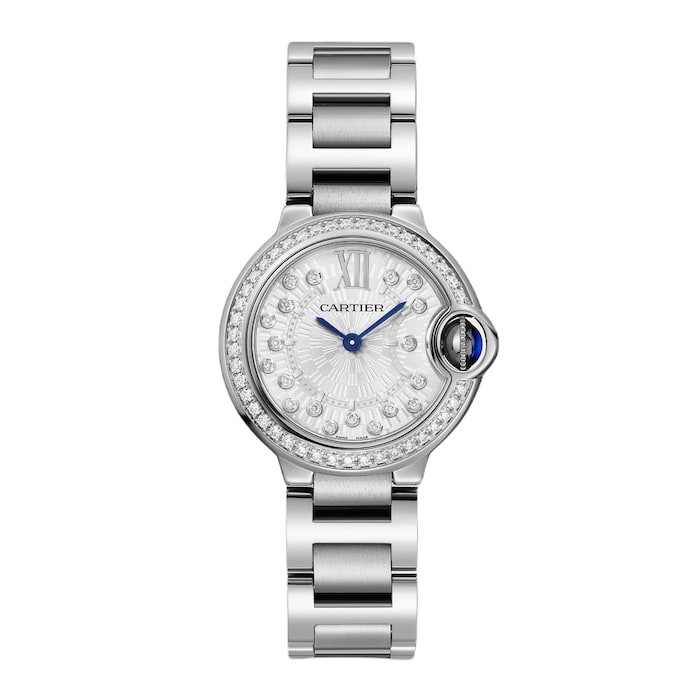
The Ballon Bleu gives Cartier’s familiar Roman numerals and blue hands a softly rounded setting. Its defining detail is the crown, enclosed by a curved extension of the case that interrupts the dial’s otherwise circular layout. A replica can capture the broad shape while missing the subtle relationship between crown, guard, and dial, so those details are a useful place to begin.
The crown and its surrounding curve
The blue cabochon-style crown sits within an opening formed by the case. The guard should appear to flow naturally from the round outline, with a smooth curve and a neatly centered crown. Look at both front and side photographs; the front reveals the opening’s shape, while the side shows how the crown sits within it.
The nearby Roman numeral and minute-track arrangement is also distinctive. Check that the printing follows the intended curve cleanly rather than looking squeezed into the available space. A blue stone-like detail does not establish its material, so any sapphire or other gemstone claim should be specified for the actual replica.
Choosing the size without relying on labels
The Ballon Bleu has appeared in a broad range of sizes, including compact 28 mm and 33 mm styles and larger 36 mm, 40 mm, and 42 mm interpretations. The rounded case can look different from a flatter watch with the same diameter. Thickness and the bracelet’s first links affect the overall presence.
Choose according to your preferred proportions rather than a gender category or a fixed wrist-size rule. Ask for the actual dimensions of the replica and a side view. A smaller version emphasizes the pebble-like shape, while a larger one gives the dial pattern and numerals more visual space.
Dial finishes and legibility
A silver patterned dial gives the Ballon Bleu a familiar Cartier appearance. Blue sunray and other color treatments create a different mood, especially as the light changes. Inspect the dial in neutral lighting so the texture and color can be judged without strong reflections or editing.
Look for clear Roman numerals, an orderly minute track, and hands that remain distinct from the background. The pattern should look consistent around the center and near the crown opening. If the design includes a date window, review its placement and number alignment separately rather than assuming every size uses the same layout.
Quartz and automatic versions
Both quartz and automatic descriptions appear among Ballon Bleu replica listings. Size alone should not be used to identify the movement. Ask which mechanism is installed, how it is set, and which displays are included. A movement name associated with an original Cartier reference does not establish what powers a replica.
Factory labels such as V6F can help identify a particular offering, but they should be paired with an exact model and version. Compare the specification with photographs of the actual watch, especially when a listing offers several sizes under one product name.
Case, bracelet, and finishing checks
- Inspect the continuity of the crown guard’s curve.
- Check that the blue crown detail is centered and neatly seated.
- Review the case surface for an even polish.
- Look at the bracelet’s connection to the rounded case.
- Ask about removable links, clasp construction, and sizing range.
- Compare the dial printing in a straight-on photograph.
Two-tone and gold-tone versions require a clear description of the underlying material and finish. Color does not establish solid gold, and matching the tone across case, bracelet, and clasp is part of the visual comparison. Stone-set versions need close photographs of the setting and an accurate description of the stones.
A round alternative within Cartier
The Ballon Bleu offers a softer outline than the square Santos or rectangular Tank. Its appeal lies in the rounded case and distinctive crown arrangement. Browse the Cartier collection at Beasts.us.com to compare individual sizes and finishes.