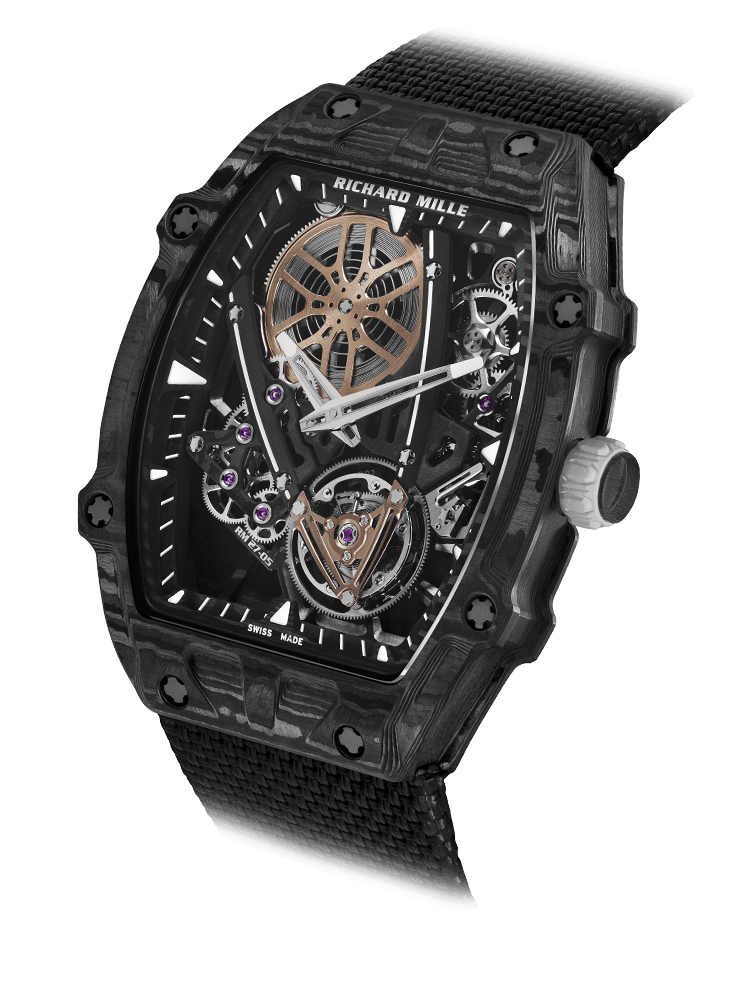
The Richard Mille RM 027 is associated with Rafael Nadal and the pursuit of an exceptionally light mechanical sports watch. Its open construction and tonneau shape make it visually distinctive, but the interest in the original goes beyond appearance. When assessing a replica-style listing, that distinction becomes essential: copying the outline does not reproduce the engineering.
Why the RM 027 attracts attention
The original concept brought a tourbillon into a sporting context where weight, movement, and shock were central concerns. The skeletal appearance makes the mechanism part of the design rather than hiding it behind a conventional dial. A sparse display places the emphasis on the movement and case construction.
The broader Nadal-associated Richard Mille family includes several different references. Their case materials, movement supports, and performance claims should not be treated as interchangeable. A listing that mixes names such as RM 027 and RM 27-04 needs clarification before any specification can be assessed.
What does a tourbillon claim mean?
A tourbillon is a mechanical assembly in which the escapement and balance are carried in a rotating cage. Its visual movement is part of the appeal, but simply seeing something rotate through an opening does not establish that a watch contains a tourbillon. Decorative elements and exposed balance wheels are different constructions.
Ask for the movement's identity and an explanation of what the visible assembly does. A close video can help show its motion, while a clear technical description can distinguish a functional mechanism from a decorative imitation. Treat a still photograph as a view of appearance, not proof of mechanical architecture.
Separate design cues from performance claims
Low weight is prominent in the RM 027 story. A replica may have a similar shape yet use a much heavier case, movement, strap, or clasp. If weight matters to you, ask for a measurement of the complete watch, including the supplied strap, and confirm which version is being measured.
The same approach applies to case materials and movement suspension. A carbon-like pattern does not prove a particular composite, and visible wires or bridges do not establish an equivalent shock-protection system. Avoid carrying a performance rating from an authentic Richard Mille reference over to a replica description.
Questions worth asking about a listing
- Which exact reference is the appearance based on?
- What is the installed movement, and is the visible rotating feature functional?
- What are the case, strap, and clasp materials?
- What are the dimensions and complete watch weight?
- Which functions can be demonstrated on the actual watch?
- Are the photographs of the unit being supplied or a sample?
A clear answer is more valuable than phrases such as “identical engineering” or “perfect clone.” Even an attractive, working replica should be described according to its own construction. Its visual resemblance does not make it an authentic Richard Mille or establish the original watch's testing history.
Compare simpler designs if the look is the priority
If what you enjoy is the curved tonneau case, skeleton-style face, or dark composite appearance, other Richard Mille-style designs may provide a clearer comparison. The RM 035 guide covers a simpler layout, while the RM 011 guide explains a busier chronograph-style face.
Use those differences to identify what you actually want to wear. A simpler display can make function easier to understand, while a more elaborate dial may appeal primarily for its design. Neither should be judged by the name alone.
Before approving any example from the Richard Mille replica collection, review its case, strap, visible mechanism, and demonstrated operations. The useful outcome is a clear account of the watch in front of you, with its appearance and capabilities described separately.