Vacheron Constantin's Historiques collection revisits distinctive designs from the brand's archive. Its appeal comes from variety: a tilted dial, sculptural chronograph lugs, a complete calendar, or an integrated bracelet can each become the starting point. Replica versions need to be assessed model by model because these watches do not share one uniform shape or function.
History expressed through design
Vacheron Constantin was founded in Geneva in 1755. That history provides a broad range of forms to revisit, but the interest of a Historiques-style watch is visible in its details. The case outline, numerals, hands, and strap attachment give each design its own personality.
A modern interpretation and the historical watch that inspired it may have different proportions or mechanisms. When comparing a replica, establish which version it follows. A collection name alone does not identify the complete specification.
American 1921: a different reading angle
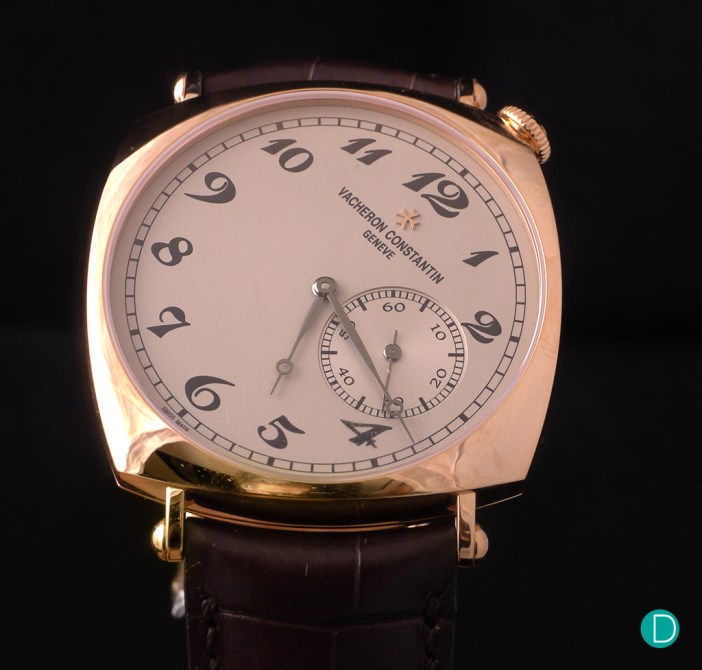
The American 1921 is recognizable for its rotated dial within a cushion-shaped case and its unusual crown position. Those features make the watch a strong alternative to a conventional round dress watch. The face remains simple enough for the unusual arrangement to be the main event.
Inspect the relationship between the dial, case, and crown rather than checking each in isolation. Numeral placement, hand length, the small-seconds display, and the curve of the case all contribute to the intended balance. An angled photo is particularly useful for understanding the cushion shape.
Cornes de Vache 1955: sculptural lugs
“Cornes de Vache” refers to the distinctive horn-shaped lugs. Their curves give this chronograph a more expressive outline than a straight-lug case. The dial adds the precision of counters and scales, creating a contrast between the fluid case and orderly face.
On a replica, inspect the symmetry of the lugs and the quality of the case edges. Request a full chronograph demonstration as well. The appearance of counters and pushers does not establish what each one does or which movement powers them.
Triple Calendrier 1942: calendar detail
A triple-calendar layout presents day, date, and month information. It offers a more detailed face for someone who enjoys reading several displays at a glance. Clean printing and a clear relationship between the hands, scale, and apertures are central to its appeal.
Confirm every displayed function on the specific replica and ask how it is adjusted. Do not treat “complete calendar,” “annual calendar,” and “perpetual calendar” as interchangeable terms. A calendar's visual layout does not establish how it handles months of different lengths.
222: the integrated-bracelet direction
The original 222 was introduced in 1977 and designed by Jorg Hysek. Its notched bezel and integrated bracelet give it a sporting identity that differs from the leather-strap designs above. A replica should be compared against the particular historical or modern version named in the listing.
Look at the transition from case to bracelet, the shape of the links, the bezel edge, and the clasp. A gold-colored appearance also needs a clear material description. Visual similarity does not establish solid-gold construction.
Choose the form, then check the execution
| Design | Main attraction |
|---|---|
| American 1921 | Rotated dial and cushion case. |
| Cornes de Vache 1955 | Curved lugs and chronograph layout. |
| Triple Calendrier 1942 | Calendar detail in a traditional case. |
| 222 | Notched bezel and integrated bracelet. |
Use the QC checklist to review the actual watch, including its stated movement and demonstrated functions. For other directions within the brand's design language, compare the Patrimony guide and the Vacheron Constantin replica collection.