The Portugieser combines the open dial of a precision instrument with the finishing of a dress-oriented watch. Its Arabic numerals, fine minute scale, and slender hands give the collection a recognizable appearance across simple automatics and more complex designs. For a replica, the balance of those elements matters just as much as the name printed on the dial.
Instrument origins, dress-watch proportions
The collection traces its origins to watches made for Portuguese customers seeking precise timekeeping in a large wristwatch. The early design used a spacious dial and a relatively narrow bezel, a combination that remains central to the Portugieser identity.
That history explains why a Portugieser can appear larger than another watch with the same case diameter. Much of its face is dial. When comparing replicas, look at the bezel width, the position of the numerals, and the amount of space between the center and the outer scale rather than judging size from a number alone.
The chronograph layout
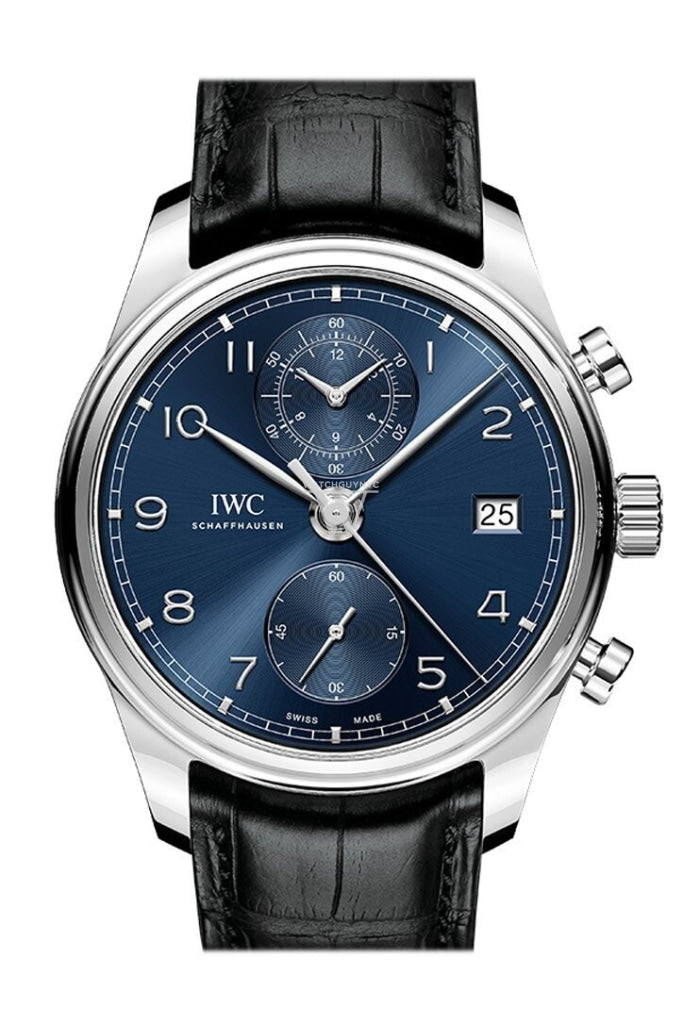
The familiar Portugieser Chronograph uses vertically arranged counters to give the dial a clear visual structure. The surrounding numerals and minute track need to remain balanced around those counters. Slight differences in subdial spacing can change the whole appearance, so a straight-on photograph is particularly useful.
Ask for a demonstration of the actual timing functions. The central chronograph hand should start and stop as described, and the timing hands should return to their starting positions after a reset performed according to the movement instructions. Do not infer the installed caliber from an engraved bridge or a listing that repeats original IWC specifications.
Automatic choices
Within the collection, the Automatic 40 offers a relatively clean layout with small seconds, while larger automatic designs can include a power-reserve indicator. The display you prefer may be more important than a small difference in diameter.
| Design | Main visual feature | Practical comparison |
|---|---|---|
| Automatic 40 | An open dial with small seconds | Case height and the proportions of the small-seconds display |
| Chronograph | Two vertically arranged counters | Counter spacing, pusher operation, and reset behavior |
| Automatic with reserve display | An additional gauge on the dial | Whether the gauge reflects the installed movement |
A seven-day scale on a replica is not proof of a seven-day power reserve. Ask for the actual running-time specification and an explanation of how the indicator operates. The original reference and the reproduction should have separate descriptions.
Calendar displays need extra care
Annual-calendar designs add calendar information to the instrument-like face. A replica may reproduce the arrangement without reproducing the complete mechanism. Confirm which displays advance automatically, which require manual setting, and whether the calendar distinguishes between different month lengths.
The controls and adjustment restrictions should be documented for the installed movement. A complicated-looking dial is not useful if its functions are unclear or difficult to maintain. If your priority is everyday readability, a simpler automatic or chronograph layout may be easier to evaluate.
Color, fit, and finishing
Silver, blue, green, and other dial colors change how prominently the polished hands and numerals stand out. Compare images in ordinary lighting and inspect the edges of applied markers, the printing of the minute scale, and the finish of the case sides.
Request the actual case diameter, thickness, and lug-to-lug measurement. The large dial can give the watch considerable presence even when it fits comfortably, while the strap and clasp determine whether it stays centered on the wrist.
For a quieter round-dial alternative, read the Portofino guide. Compare the different approaches together in the IWC collection.