Hublot’s MP Series treats the wristwatch as a platform for unusual displays and visible engineering. The MP-05 LaFerrari, MP-11, and MP-09 approach that idea in different ways, from rows of barrels to an exposed tourbillon. A replica can echo their dramatic appearance, but the exterior alone says little about whether the underlying complication has been reproduced.
Start with the individual MP design
MP is not a single case shape or movement layout. The collection groups experimental watches with distinct mechanical ideas. Choosing by the general MP name can therefore lead to confusion: the feature that attracts you in one model may have no equivalent in another.
| Design | Visual focus | Question for a replica listing |
|---|---|---|
| MP-05 LaFerrari | An elongated case and cylinder-based displays | Which displays work, and how are they set? |
| MP-11 | A prominent row of visible barrels | Which visible components are functional? |
| MP-09 | A tourbillon presented in an extended lower case | What kind of mechanism is actually installed? |
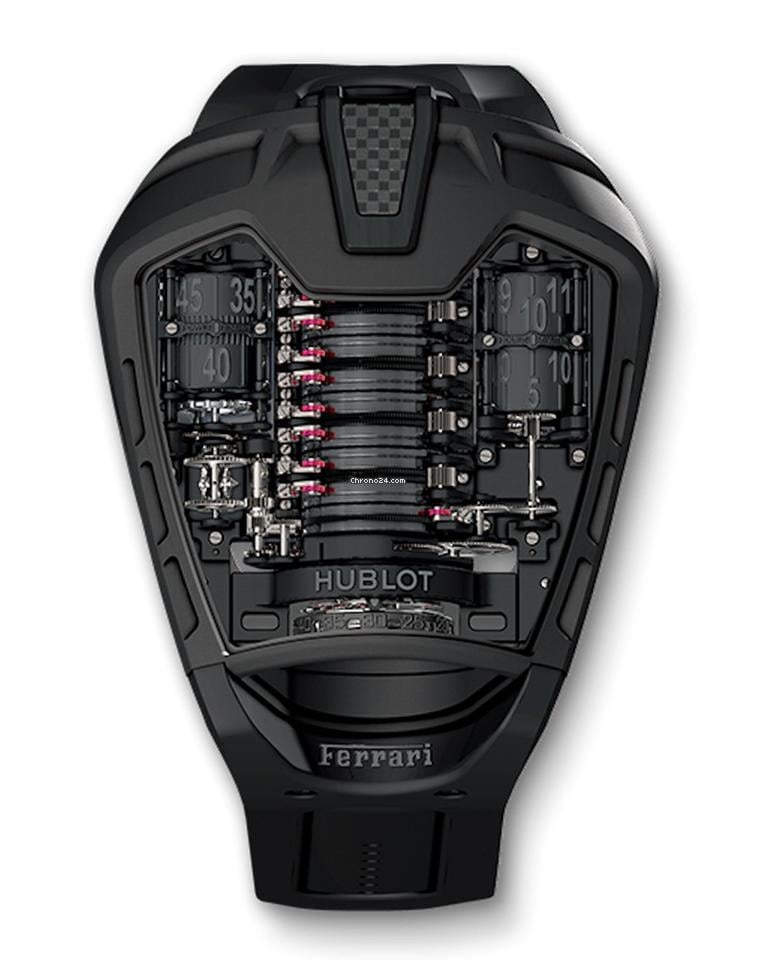
MP-05 LaFerrari: appearance and operation
The MP-05 LaFerrari’s engine-like arrangement is central to its identity. Its original design is associated with eleven barrels and an exceptional fifty-day power reserve. Those details belong to the original watch. They should not be transferred to a reproduction merely because similar cylinders can be seen through its crystal.
Request a complete demonstration of the time display and winding method. The seller should identify which elements move, what each display represents, and the actual operating instructions. If the main attraction is the original mechanical concept, a visually similar case with a simpler movement may not meet that expectation.
MP-11: a different arrangement
The MP-11 places its visible barrel arrangement in a format more closely connected to Hublot’s familiar round-case designs. That changes the composition, but it does not make every reproduction mechanically comparable to the original. A row of barrel-shaped components can be part of the decoration rather than a connected power system.
Ask for the measured power reserve of the offered watch instead of accepting a figure copied from an original reference description. Clear documentation is especially useful when a listing combines original-model specifications with photographs of a replica.
MP-09: identify the moving component
The MP-09’s projecting lower case makes the exposed mechanism the focal point. The distinction between a rotating tourbillon, a simpler exposed balance, and a decorative assembly matters here. A short video can clarify what moves, though it does not by itself verify every technical claim.
Request the movement type in plain language and ask who can service it. Parts availability and repair options should be established for the installed mechanism, not assumed from the Hublot name on the case.
Materials, dimensions, and practical limits
Transparent cases, carbon-pattern surfaces, and contrasting finishes are part of the MP vocabulary. Each requires a separate material description. A transparent case may use a material other than sapphire; a carbon appearance does not establish a particular composite construction. Avoid judging either from weight or a photograph alone.
- Obtain width, length, and thickness measurements for the actual watch.
- Check how the strap curves around the wrist and where the clasp rests.
- Ask whether controls or projecting case sections interfere with normal wrist movement.
- Confirm the documented functions, adjustment procedure, and service options.
The MP Series makes sense as a visual choice only when its limitations are clear. If you prefer a more conventional case and controls, compare the Big Bang or the Classic Fusion within the Hublot collection.