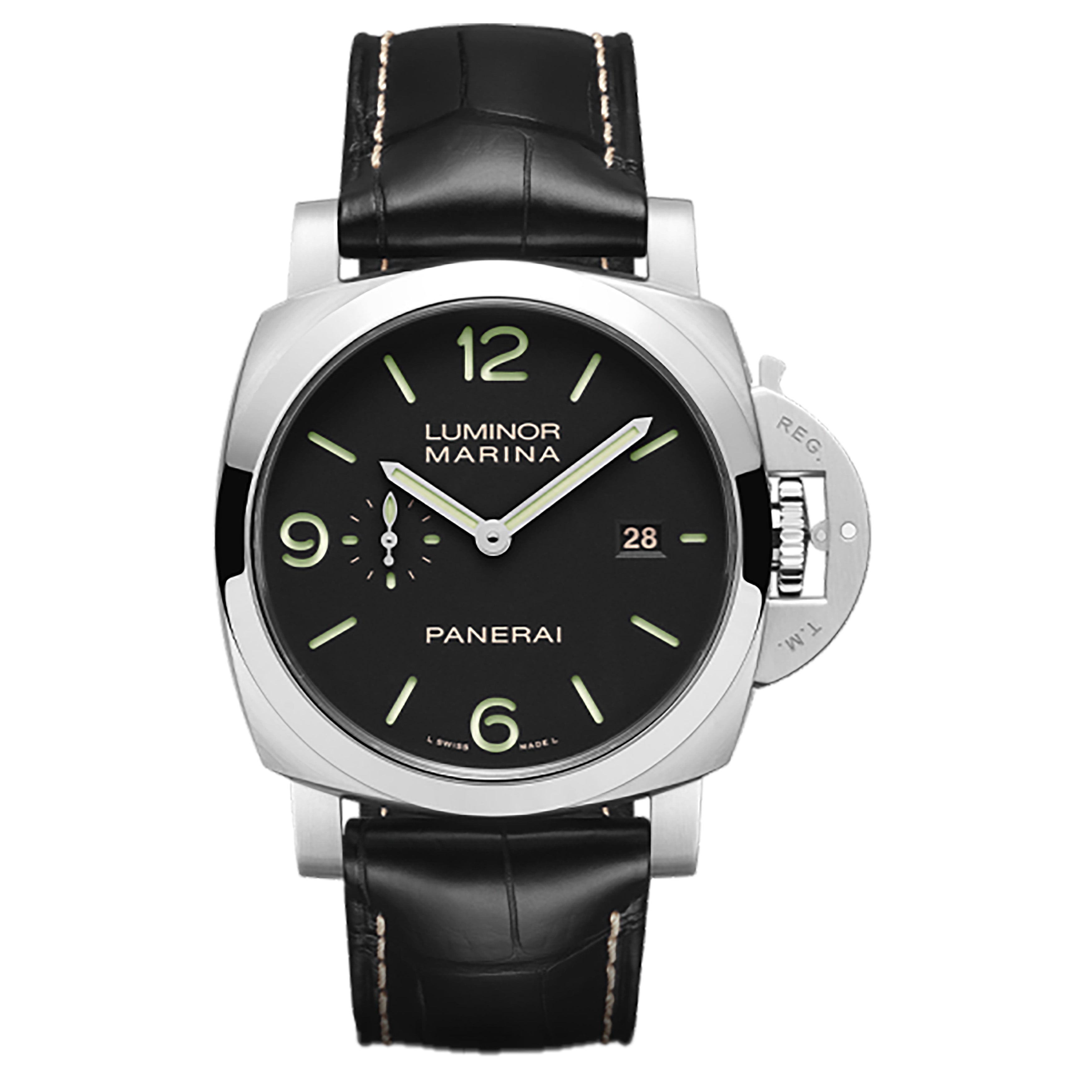
The Panerai Luminor uses a few large design elements to make a strong impression: a cushion-shaped case, broad hands, clear numerals, and the crown-protecting bridge at its side. The dial can be simple while the case remains substantial. When comparing a Luminor replica, focus on the relationship between those parts and the documented functions of the actual watch.
The crown bridge defines the outline
The Luminor’s bridge and lever are central to its identity. They distinguish it from the exposed-crown Radiomir and add an asymmetric shape to the case. Their size, position, and finishing have a noticeable effect on how the whole watch looks.
Inspect the fit of the bridge against the case and ask for a video of the lever operating. It should behave as described and remain secure when closed. Do not force a stiff lever or assume that a copied crown guard provides the same sealing or protection as an original Panerai assembly.
Base and Marina dial layouts
The simplest Luminor Base designs emphasize hours and minutes. Marina designs add a small-seconds display, and some references also include a date. Those additional details change the dial’s balance, so compare the specific reference rather than expecting every Marina to use the same layout.
Large numerals and an open dial make printing and hand placement easy to judge. Look for consistent edges, aligned markers, and a clear distinction between the hour and minute hands. A date window, where present, should be centered within its opening and visually integrated with the surrounding dial.
Understanding the sandwich dial
A sandwich dial uses layers: cutouts in the upper dial reveal luminous material beneath. That construction produces visible depth around the numerals and markers. It is one of Panerai’s best-known visual features, though not every Luminor reference uses it.
If a replica is described as having a sandwich dial, request angled photographs to see the cutouts. A printed numeral can create a similar outline in a small image without the same depth. Even luminous application matters more than a single bright photograph taken immediately after exposure to light.
Choosing the case size
Traditional Luminor designs include substantial 44mm and 47mm examples, while the Luminor Due provides another direction with slimmer proportions. The stated diameter does not include everything you will feel on the wrist: case height, lug length, crown-bridge width, and strap stiffness all matter.
- Request measured width, thickness, and lug-to-lug length.
- Compare the side profile with a watch that fits your usual clothing.
- Check whether the strap curves down naturally at the lugs.
- Confirm the buckle size and the usable strap adjustment range.
Movement and strap choices
Manually wound and automatic arrangements appear across the Luminor story. A replica should identify its own mechanism, winding method, date behavior, and stated reserve. An original caliber number printed in a listing or engraved on a bridge does not independently verify what is installed.
Straps are a large part of the Panerai look. Brown leather emphasizes the military-inspired styling, black rubber-style straps give a more technical appearance, and fabric changes the balance again. Confirm the attachment type and strap width for the actual case rather than assuming universal compatibility.
For a slimmer interpretation, read the Luminor Due guide. To compare a rotating-bezel design, explore the Submersible guide within the Panerai collection at Beasts.us.com.