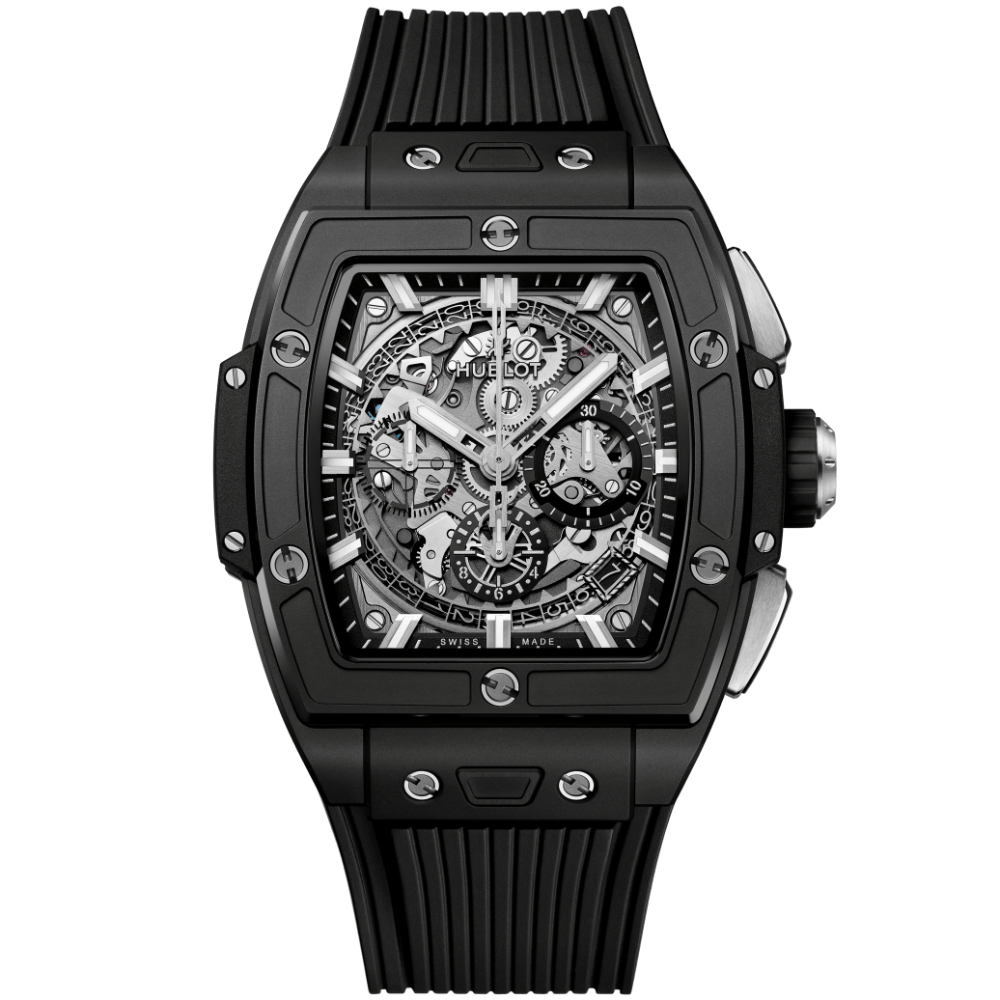
The Spirit of Big Bang carries Hublot’s layered construction and visible hardware into a tonneau, or barrel-shaped, case. Its long, curved outline changes the way the dial is framed and the way the watch occupies the wrist. A replica should be evaluated as its own product, with particular attention to case geometry, strap fit, and the functions behind the open dial.
Why the tonneau case matters
A round watch can often be described reasonably well by its diameter. A tonneau design needs more context. Width, overall length, thickness, and the curve of the underside all influence fit. Two watches with the same stated width can feel quite different if one extends farther along the wrist.
The Spirit’s layered bezel and case sides reinforce that elongated shape. Check photographs from the front, side, and back. The transitions between surfaces should look deliberate, with consistent brushing or polishing around the curves. A front-facing promotional image alone cannot show whether the case sits flat or rocks against the wrist.
Compare smaller and larger formats
The supplied guide includes 39mm and 42mm formats. Treat these as reference points, then confirm the measurements of the specific reproduction. A smaller case may offer the same visual vocabulary with less wrist coverage, while a larger case gives the skeleton-style display more room.
Do not choose solely from a suggested wrist circumference. The shape of your wrist and the stiffness of the strap also matter. Compare the distance between the outermost strap attachment points with a watch you already own, and check whether the strap can curve downward without leaving a large gap.
Look at the dial as a complete layout
The tonneau frame changes the balance of an open dial. Hour markers, subdials, bridges, and visible wheels need to work together without making the hands difficult to locate. Under angled light, a genuinely layered assembly should have visible depth, but depth alone does not prove that every exposed component is functional.
Choose legibility as deliberately as color. Dark hands can disappear against a dark mechanism, while brightly finished components may reflect light. Request ordinary photographs in addition to strongly lit studio images so you can judge the time display in realistic conditions.
Movement descriptions need precision
The Spirit collection includes different mechanical concepts, and a listing should identify the particular design being represented. Do not assume that the movement in a Spirit replica matches a round Big Bang or that similar-looking versions use the same mechanism.
For a chronograph, ask which counters operate and request a start, stop, and reset demonstration. For a version with a power-reserve display, ask whether the indicator tracks the installed movement’s remaining run time. An original-model name or an engraved movement designation is not evidence of identical construction or performance.
Case finishes and the parts you touch
Titanium-style gray, black finishes, and warm gold tones each change the appearance of the curved case. Material claims should name the actual case and bezel materials, including any coating. Hublot’s King Gold terminology should not be taken to mean that a replica uses the original precious-metal alloy.
- Inspect bezel screws for clean, undamaged heads and even seating.
- Check the crown and pushers for a neat fit against the case.
- Look for smooth strap edges and a secure, comfortable clasp.
- Confirm replacement-strap compatibility and the available adjustment range.
The Spirit suits someone drawn to the case shape as much as the dial. For a direct design comparison, read the round Big Bang guide. The Hublot collection at Beasts.us.com also provides a starting point for comparing finishes and proportions.